How to Reset Your Skincare Routine After a Bad Reaction
When your skin reacts badly, the smartest move is usually to simplify. Learn how to pause, rebuild, and reintroduce products without making the flare worse.

# How to Reset Your Skincare Routine After a Bad Reaction
A bad skincare reaction can make even confident people second-guess everything on the bathroom shelf. One day the routine feels normal. The next day the skin is stinging, red, bumpy, itchy, peeling, burning, or breaking out in a way that does not feel like ordinary skin behaviour.
The natural response is to do something quickly. Wash more. Apply a calming mask. Use acne treatment. Layer barrier cream. Search for a rescue product. Unfortunately, the fastest way to calm angry skin is often to stop adding new things.
A reset routine is not glamorous. It is a temporary pause that gives the skin enough quiet to recover and gives you enough clarity to identify what went wrong.
First, decide whether this is urgent
Some reactions need medical advice, not a home reset. Seek help if you have swelling around the eyes or lips, difficulty breathing, widespread hives, severe pain, blistering, pus, infection signs, intense burning, or a rash spreading quickly.
Also seek advice if the reaction involves the eyelids, a baby or young child, known eczema, pregnancy-related medication concerns, or prescription treatments. Skincare troubleshooting has limits.
For milder reactions such as stinging, redness, tightness, roughness, small bumps, or barrier discomfort, a careful reset may help.
Stop the likely triggers
Pause products that commonly irritate: exfoliating acids, retinoids, vitamin C, benzoyl peroxide, scrubs, peeling masks, strong acne treatments, fragranced masks, essential oils, and new products introduced recently.
Do not try to “push through” burning or stinging because a product is expensive or popular. Repeated irritation can make recovery slower.
If you started several products at once, stop all non-essential steps first. You can investigate later. During the flare, your job is to reduce noise.
Keep only the basics
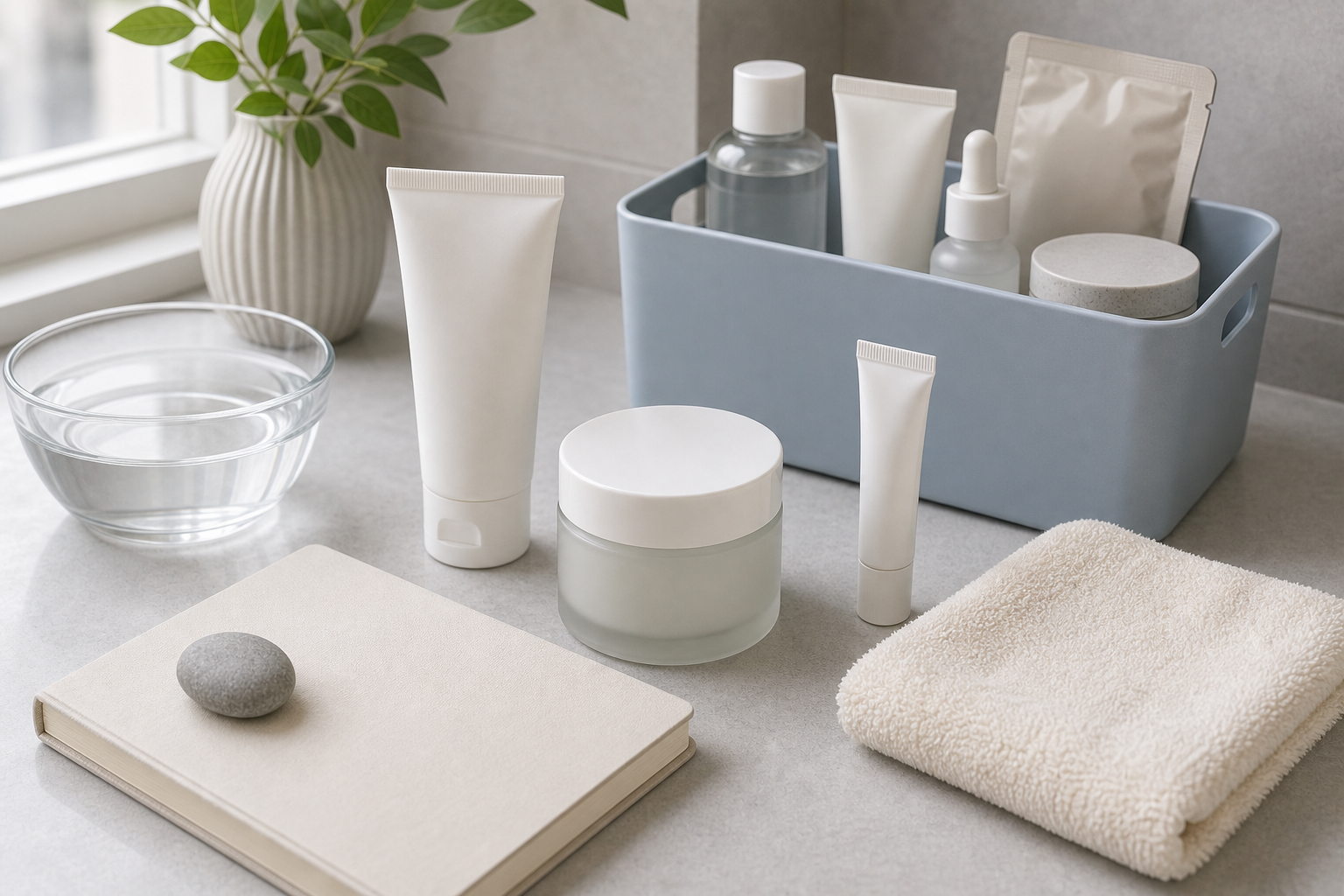
For a reset, keep the routine as plain as possible: gentle cleansing, moisturising, and daytime protection if tolerated and needed. If even your usual products sting, simplify further.
A very basic routine might look like this:
Morning: rinse with water or use a gentle cleanser only if needed, apply a bland moisturiser
Day: avoid unnecessary products and heavy makeup if the skin is sore
Night: gentle cleanser, bland moisturiser, optional thin layer of ointment on dry cracked areas
This is not forever. It is a short recovery phase.
Choose boring products on purpose
During a reset, boring is a feature. Look for gentle cleansers that do not leave the skin tight. Choose moisturisers with simple barrier-supporting ingredients such as glycerin, panthenol, ceramides, squalane, petrolatum, dimethicone, or colloidal oatmeal if tolerated.
Avoid products that advertise instant resurfacing, strong glow, detox, peeling, pore clearing, or intense brightening. Even if those products are good in normal times, they may not be right during a reaction.
Fragrance-free is often safer when skin is upset. This does not mean fragrance is always bad. It means irritated skin has less patience.
Do not over-cleanse
When skin feels dirty, congested, or inflamed, it is tempting to cleanse repeatedly. But over-cleansing can strip the barrier and keep the reaction going.
Use lukewarm water. Massage gently. Rinse well. Pat dry. If you wear water-resistant makeup or heavy sunscreen, remove it carefully with a mild first cleanse, then follow with a gentle cleanser only if needed. Do not scrub the skin raw to prove it is clean.
If your skin is painful or very dry, a non-foaming cleanser may feel better for a while.
Give the skin a real pause
Many people reset for one day and then reintroduce actives too quickly. Barrier recovery takes time. A mild reaction may calm in a few days. A stronger irritation pattern may need one to two weeks of simplicity.
Look for signs of recovery: less stinging, less heat, less tightness, fewer rough patches, and moisturiser feeling comfortable again. Do not restart active products just because redness is slightly improved.
The skin should feel boring before the routine gets interesting again.
Reintroduce products one at a time
Once the skin is calm, add products back slowly. Introduce one product at a time and use it for several days before adding another. This helps you identify the problem if irritation returns.
Start with the products least likely to irritate, such as a familiar hydrating serum or moisturiser. Leave stronger treatments for later.
For retinoids and exfoliating acids, restart at a lower frequency than before. If you used an acid toner four nights a week before the reaction, do not return immediately to four nights. Begin once weekly or less and watch the skin.
How to identify the likely culprit
Ask what changed. Did you add a new product? Increase frequency? Combine actives? Change cleanser? Start a new makeup remover? Use a mask? Get a facial? Shave, wax, or thread? Spend more time in air-conditioning? Wear heavier makeup? Use a new laundry detergent on pillowcases?
Sometimes the problem is not one bad product. It is the combination: retinol plus acid, vitamin C plus scrub, exfoliating cleanser plus peeling mask, or active products applied too close together.
Write down the timeline if needed. Memory gets fuzzy when five products are involved.
Breakouts after a reaction
Not every post-reaction breakout is purging. Purging is linked to ingredients that increase cell turnover, such as retinoids or exfoliating acids, and it usually appears in areas where you already break out.
If new bumps appear in unusual places, feel itchy, burn, or come with redness and roughness, irritation may be more likely than purging.
Do not attack irritation breakouts with every acne treatment at once. Calm the barrier first. Then decide whether acne treatment is actually needed.
Makeup during a reset
If your skin is sore, give makeup a break if possible. If you need to wear makeup, choose products that remove easily and avoid heavy layers over broken or peeling areas.
Be gentle during removal. Many reactions are extended by aggressive cleansing at night. A soft hand matters more than a perfect makeup look during recovery.
Clean brushes and sponges too. Irritated skin does not need old product residue or bacteria adding to the story.
The emotional part is real
A bad reaction can feel embarrassing, especially if your face is visibly red, bumpy, or flaky. It is easy to blame yourself for using the wrong product or trying too much.
Try not to turn recovery into panic-shopping. Most skin needs fewer decisions during a flare, not more. A calm reset is not doing nothing. It is active restraint.
The practical takeaway
When skin reacts badly, the best routine is usually smaller.
Stop likely triggers. Cleanse gently. Moisturise with boring products. Avoid new experiments. Let the skin become comfortable again before reintroducing products one at a time.
The reset is not a punishment. It is a way to make the skin quiet enough that you can hear what it is telling you.

