Itchy Face After Skincare: Common Causes and What to Pause First
An itchy face after skincare can come from irritation, allergy, barrier damage, fragrance, actives, or over-layering. Here is how to simplify without guessing wildly.

# Itchy Face After Skincare: Common Causes and What to Pause First
An itchy face after skincare is not something to ignore. It can be mild and temporary, or it can be an early warning that your skin is irritated, allergic, over-treated, or reacting to a product.
The difficult part is that itch does not point to one single cause. A cleanser can cause it. A moisturiser can cause it. A serum can cause it. A damaged barrier can make everything itch. Heat, sweat, masks, fragrance, actives, and over-layering can all contribute.
The right response is not to panic. It is to reduce variables and listen carefully.

Itch is different from a brief tingle
Some products create a brief mild sensation, especially exfoliating acids or certain vitamin C formulas. But itch that persists, spreads, returns every time, or comes with redness, bumps, swelling, or burning deserves attention.
Do not keep using a product because someone online said tingling means it is working. Your face is allowed to object.
Itch often means the skin barrier or immune response is involved in some way. That deserves caution.
Common cause: barrier damage
Barrier damage can make ordinary products feel itchy or stingy. This may happen after over-exfoliation, retinoid overuse, harsh cleansing, strong acne treatments, sunburn, procedures, or too many product changes.
If moisturiser suddenly itches, the moisturiser may not be the only problem. Your skin may be sensitised.
Signs include tightness, shiny skin, peeling, burning, redness, and products that used to be fine suddenly feeling uncomfortable.
Common cause: fragrance or essential oils
Fragrance can trigger itching for some people, especially in leave-on products. Essential oils and botanical scent compounds can do the same.
If the itchy product smells strong, herbal, floral, citrusy, spa-like, or perfumed, fragrance is worth considering.
This does not mean every fragranced product is bad for everyone. It means itchy skin should not be forced to tolerate fragrance for the sake of a nice experience.
Common cause: strong actives
Retinoids, exfoliating acids, benzoyl peroxide, strong vitamin C, peeling masks, and acne treatments can create itch when overused or layered aggressively.
Sometimes the active is useful, but the frequency is wrong. Sometimes the formula is too strong. Sometimes the skin is not ready.
If itch started after adding an active, reduce or pause it first.
Common cause: over-layering
Using many products can make it hard to identify the trigger. Toner, essence, serum, ampoule, moisturiser, oil, sunscreen, and makeup all have formulas. Any one could irritate, and together they can overwhelm the skin.
If the face itches after the whole routine, simplify. Do not add another calming serum on top of eight products and hope it solves the mystery.
Fewer steps make the pattern clearer.
What to pause first
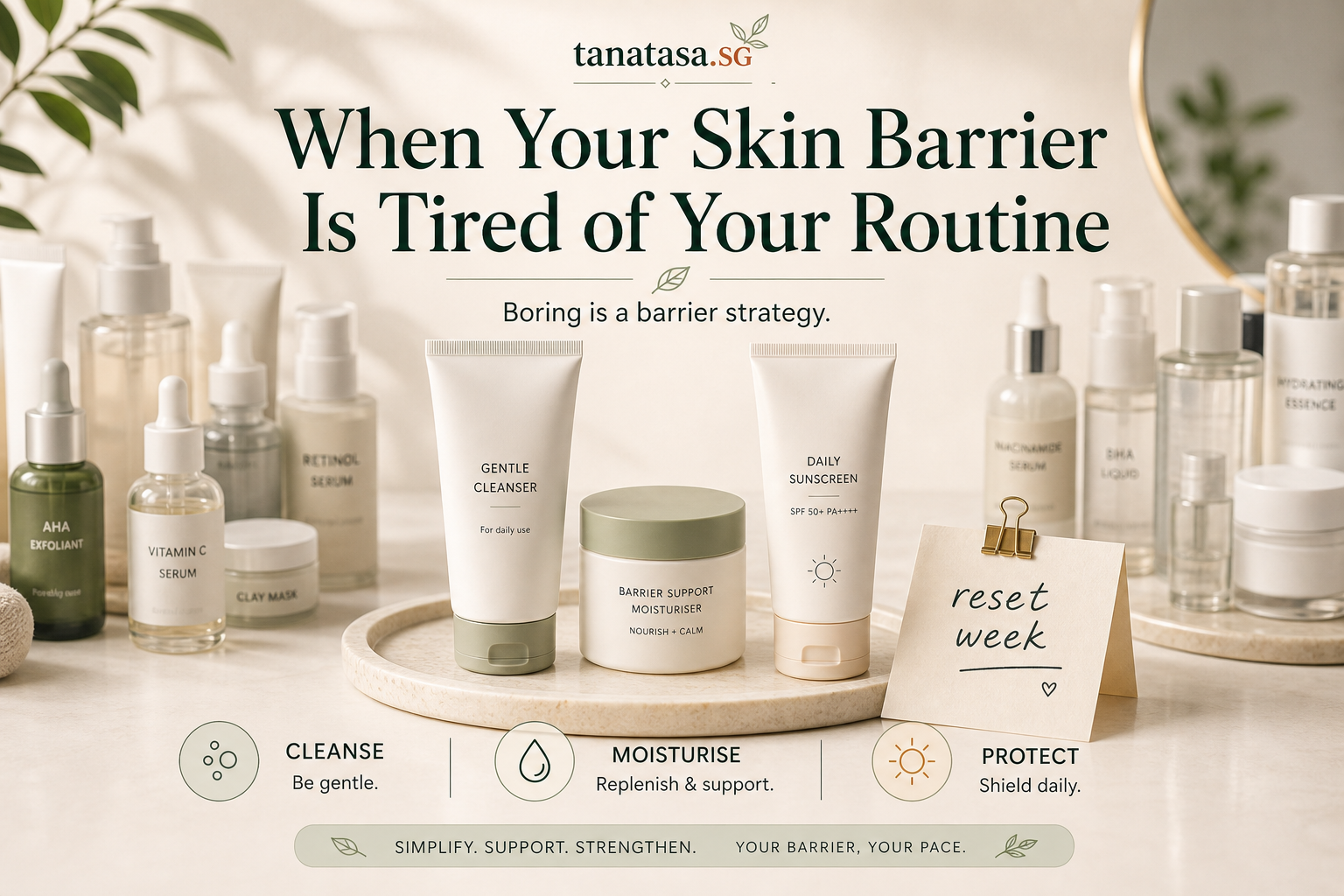
Pause non-essential actives first: acids, retinoids, benzoyl peroxide, scrubs, strong vitamin C, peeling masks, and new treatments. Pause fragranced leave-on products if possible. Stop any product that clearly triggers itch every time.
Keep a gentle cleanser, a plain moisturiser, and sunscreen if tolerated.
If even bland moisturiser itches, the skin may need a repair period or medical advice depending on severity.

Do not scratch or scrub
Itchy skin invites scratching, but scratching adds inflammation and can create more irritation or marks. Scrubbing also worsens the cycle.
If the skin feels itchy, cool compresses may help some people, but avoid applying random home remedies, acids, or harsh masks.
Treat itch as a signal, not a challenge to defeat with force.
Patch testing helps, but has limits
Patch testing a product on a small area can help identify obvious reactions, but it does not catch everything. Some reactions are delayed. Some only appear after repeated use. Some happen when products are layered.
If your face is already irritated, patch testing many new products can still be too much.
Use patch testing as a tool, not a guarantee.
When it may be allergy
Allergic reactions can involve itching, redness, swelling, rash, hives, or worsening with repeated exposure. Eyelids, lips, and neck can be especially reactive.
If swelling, hives, breathing symptoms, severe rash, or eye involvement occurs, seek medical care urgently. If itch keeps recurring with products, consider professional evaluation.
Allergy is not something to solve by buying more skincare.
Rebuild slowly
Once itch settles, reintroduce products one at a time. Start with essentials. Add treatments only after the skin is comfortable.
If the same product triggers itch again, stop using it. If a category repeatedly causes problems, such as fragranced creams or acid toners, avoid that category for now.
Your routine should become easier to understand after a reaction, not more complicated. The win is not finding ten new rescue products; it is finding the few products your skin can trust again.
Timing gives clues
Immediate itching after one product may point toward that product, especially if it happens repeatedly. Itching that appears hours later may be harder to trace. Itching that builds over several days may suggest barrier damage, cumulative irritation, or delayed sensitivity.
Morning-only itch may involve cleanser, vitamin C, sunscreen, makeup, or heat during the day. Night-only itch may involve retinoids, acids, richer creams, hair products on the pillow, or cleansing habits.
The timing does not prove the cause, but it narrows the suspect list.
Keep a short itch diary
For one week, write down what you used, where the itch appeared, how quickly it started, and whether there was redness, swelling, bumps, or peeling. Also note masks, exercise, heat, new hair products, and makeup.
This does not need to become a full research project. A few notes can reveal patterns that memory misses.
If you later seek medical advice, those notes can also make the conversation clearer.
Do not forget hair and laundry products
Sometimes the itchy-face trigger is not a face product. Hair conditioner, leave-in treatment, hair oil, fragrance, pillowcase detergent, fabric softener, or mask detergent can touch the cheeks, jaw, neck, and hairline.
If itch appears near the hairline, jaw, neck, or cheeks, think beyond the skincare shelf. Rinse hair products well, keep heavy hair styling products off the face, and notice whether itch worsens after fresh laundry or certain masks.
The practical view
An itchy face after skincare can come from barrier damage, fragrance, actives, over-layering, allergy, or a product that simply does not suit you.
Pause the obvious irritants. Simplify. Avoid scratching and scrubbing. Rebuild slowly. Seek help for swelling, severe rash, eye involvement, infection signs, or persistent symptoms.
Skincare should not leave your face negotiating with itch every night. If it does, the routine is asking for revision.