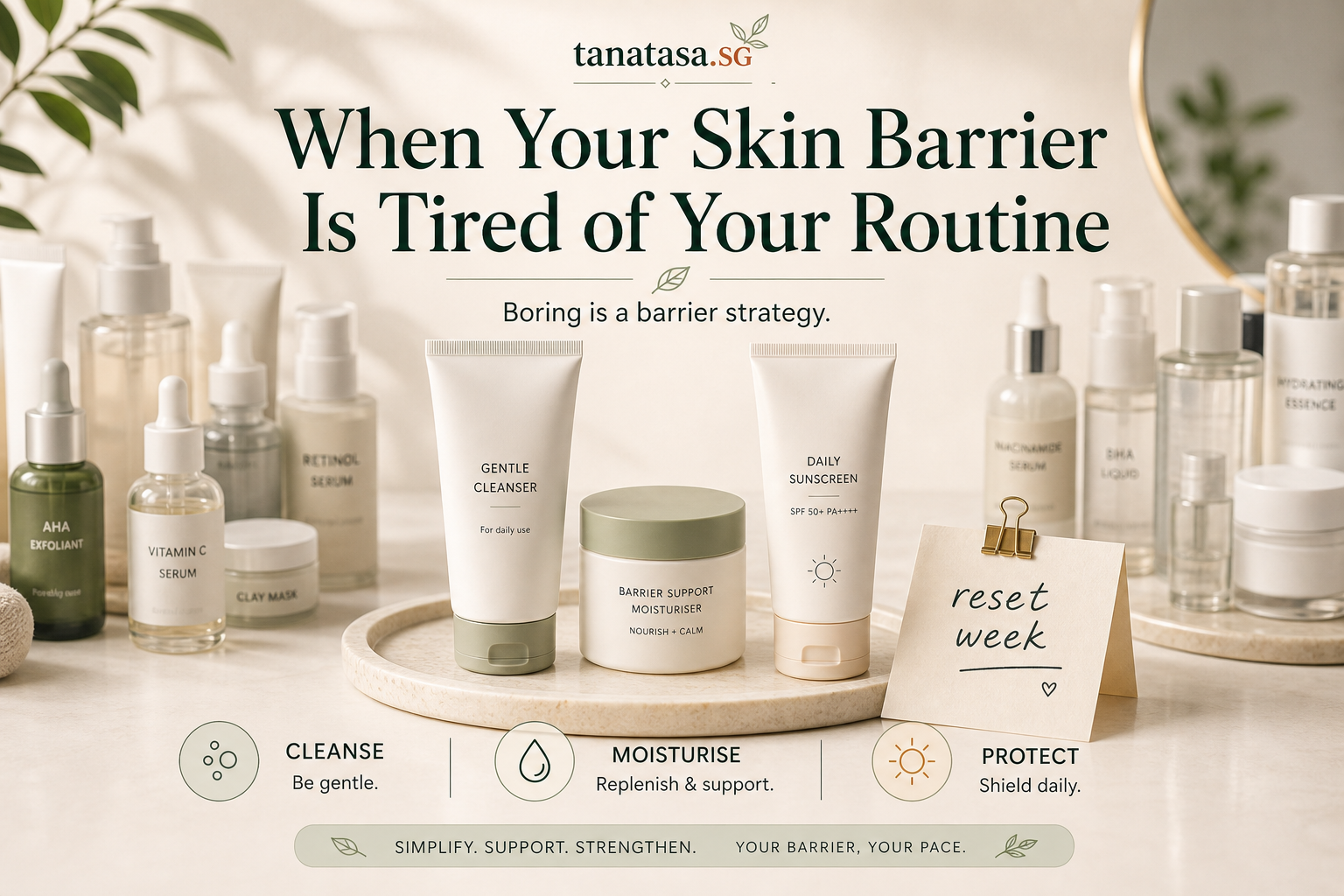
How to Repair Your Skin Barrier After Over-Exfoliating
When skin feels tight, shiny, stingy, or suddenly reactive, the answer is usually not another active. Here is how to pause, simplify, and rebuild comfort.

# How to Repair Your Skin Barrier After Over-Exfoliating
Over-exfoliation rarely announces itself with one dramatic moment. More often, it creeps in. Your skin starts feeling a bit tight after cleansing. A serum that used to feel fine begins to sting. Sunscreen feels sharper. Makeup catches on small flakes. The face looks shiny but uncomfortable, as if it is both oily and dry at the same time.
It is easy to misread this as a need for more treatment. More exfoliation for the flakes. More acne products for the bumps. More brightening products for the uneven tone. But when the barrier is irritated, adding more actives usually makes the problem louder.
Barrier repair is not glamorous, but it is one of the most useful skincare skills. It teaches you when to stop pushing and let the skin become comfortable again.
What the skin barrier does
The skin barrier is the outer protective layer that helps keep water in and irritants out. When it is working well, skin feels more flexible, less reactive, and better able to tolerate normal products.
When the barrier is stressed, the skin can lose water more easily and become more sensitive to ingredients, cleansing, friction, sweat, and environmental changes. Products that were once comfortable may suddenly feel spicy. This does not always mean you have developed a permanent allergy. Sometimes it means the skin is temporarily more vulnerable.
Barrier repair means reducing stress and giving the skin enough support to settle.
Signs you may have over-exfoliated
You may have pushed too far if:
Skincare stings more than usual.
Skin feels tight but looks shiny.
Small flakes appear around the nose, mouth, or cheeks.
Redness lasts longer than normal.
Breakouts look irritated rather than typical.
Makeup clings to rough patches.
Your usual moisturiser stops feeling sufficient.
Cleansing feels uncomfortable even with a gentle cleanser.
Over-exfoliation can come from acids, scrubs, peels, cleansing brushes, retinoids, acne treatments, or stacking too many active products. It can also happen after facial treatments if the routine restarts too aggressively.

First step: stop the active products
When the barrier is upset, the first move is subtraction. Pause exfoliating acids, scrubs, retinoids, benzoyl peroxide, strong vitamin C, peels, and any product that tingles or burns. This is not quitting forever. It is giving the skin a quiet period.
Do not replace one active with another because the first one irritated you. Switching from glycolic acid to salicylic acid, then to retinol, then to a brightening serum keeps the skin in a constant negotiation.
For a short recovery period, boring is the point.
Keep cleansing gentle
Cleansing should not make recovering skin feel tight. Use a mild cleanser at night and consider rinsing with water in the morning if your skin tolerates it. Avoid hot water, scrubs, cleansing brushes, and long cleansing sessions.
If you wear makeup or water-resistant sunscreen, use a gentle cleansing oil or balm first, then a mild second cleanser. Do not rely on rubbing harder. Let the first cleanser dissolve the layer.
After washing, pat dry. The towel should not be another exfoliation tool.
Use a simple moisturiser
During barrier repair, a moisturiser should focus on comfort. Look for ingredients such as glycerin, panthenol, ceramides, cholesterol, fatty acids, squalane, allantoin, or colloidal oatmeal. You do not need all of them. You need a formula your skin accepts.
Avoid moisturisers that sting, feel heavily fragranced, or contain many active extras. This is not the time for a moisturiser that also exfoliates, brightens, resurfaces, or promises instant glass skin.
Apply moisturiser while the skin is slightly damp if that feels comfortable. If the skin is very dry, use a second thin layer on tight areas rather than one thick layer everywhere.
Occlusives can help, but use them wisely
Occlusives help reduce water loss. Petrolatum, dimethicone, and richer balms can be useful on very dry or irritated patches. But not everyone enjoys an occlusive layer across the whole face, especially if they are acne-prone or dislike heaviness.
Use targeted occlusion if needed: around the mouth, nose corners, cheeks, or flaky patches. Apply a thin layer over moisturiser at night. Avoid placing heavy balm over active acne if it seems to worsen congestion.
The goal is comfort, not coating the face until it cannot breathe.
How long does barrier recovery take?
Mild irritation may settle in a few days. More noticeable over-exfoliation can take one to three weeks. If the skin is very inflamed, cracked, or repeatedly irritated, it may take longer and may need medical advice.
During recovery, progress can be quiet. The skin stings less. Cleansing feels normal again. Flakes reduce. The face feels less tight after washing. These are good signs even if texture is not perfect yet.
Do not restart actives the moment the skin improves for one day. Give it a little more time.
What about acne during recovery?
This is where people get nervous. If acne appears while the barrier is irritated, it is tempting to use more acne treatment. But irritated skin can also create bumps, clogged-looking texture, and angry breakouts.
For a short period, focus on calming the skin. Use gentle cleansing, moisturiser, and only essential acne medication if prescribed or clearly tolerated. If you are under dermatology care, follow that plan.
Once the barrier feels stable, reintroduce acne actives slowly. A routine that controls acne but destroys comfort is not stable long term.
When to reintroduce actives
Bring back one active at a time. Start at a lower frequency than before. If you were exfoliating three times a week, restart once a week. If you used retinoid nightly, restart two or three nights a week if appropriate.
Separate active nights. Do not restart exfoliation, retinoid, vitamin C, and acne treatment all in the same week unless you already know your skin can handle it.
Watch for early warning signs: stinging, tightness, sudden shine, flaking, or redness. If they return, reduce frequency again.

A simple barrier-repair routine
Morning:
Rinse or gentle cleanse, simple moisturiser, protection as needed for the day.
Night:
Gentle cleanse, moisturiser, targeted occlusive on dry patches if needed.
That may look too simple, but that is the point. A barrier-repair routine should not be a new ten-step routine. It should remove unnecessary decisions while the skin calms down.
What not to do
Do not scrub flakes. Moisturise them and let them shed naturally.
Do not use a peel to fix roughness caused by over-exfoliation.
Do not test several new products at once. If the skin reacts, you will not know which product caused it.
Do not assume burning means working. Burning means the skin is unhappy.
Do not chase perfect texture during recovery. Comfort comes first.
When to seek help
Seek medical advice if your skin is cracked, bleeding, oozing, swollen, very painful, infected-looking, or not improving despite a gentle routine. Also seek help if rashes spread, eye areas swell, or you have a known skin condition that is flaring.
Skincare can support mild barrier stress, but persistent inflammation deserves proper care.
The bottom line
Over-exfoliated skin needs less ambition and more steadiness. Pause actives. Cleanse gently. Moisturise simply. Protect the skin from friction and unnecessary experimentation. Give recovery enough time before restarting treatment products.
The skin barrier is not repaired by one heroic product. It is repaired by several boring choices repeated long enough for the skin to feel safe again.