How to Read Beauty Reviews Without Getting Fooled by Hype
Beauty reviews can be useful, but lighting, skin type, sponsorships, trends, and unrealistic timelines can mislead. Learn how to read reviews more critically before buying.

# How to Read Beauty Reviews Without Getting Fooled by Hype
Beauty reviews can be helpful. A good review can show texture, shade, finish, packaging, wear time, fragrance, and how a product behaves in real life. Reviews can save money and prevent bad purchases.
But reviews can also mislead. Lighting changes everything. Filters smooth texture. Sponsored content may sound neutral. A product that works beautifully for one skin type may fail on yours. A two-day impression can become a miracle claim. A viral product can feel more trustworthy simply because everyone is repeating the same enthusiasm.
Reading beauty reviews well is a skill.

Start with skin type
Before trusting a review, ask whether the reviewer has skin similar to yours. Oily skin, dry skin, acne-prone skin, eczema-prone skin, deeper skin tone, fair skin, sensitive skin, mature skin, and humid-weather routines all change product experience.
A moisturiser that feels lightweight on dry skin may feel greasy on oily skin. A sunscreen that looks invisible on fair skin may leave cast on deeper skin. A retinol that is easy for experienced users may irritate beginners.
Similarity is not everything, but it matters.
Look for the use case
A product can be excellent for one use case and poor for another. A sunscreen may be beautiful under makeup but weak for swimming. A cleanser may remove light sunscreen but not heavy makeup. A moisturiser may suit air-conditioned nights but feel too rich outdoors.
Good reviews explain context: how the product was used, what was layered with it, and what kind of day it was tested on.
Avoid treating every positive review as proof the product will suit your use case.
Be suspicious of instant miracles
Some products give instant cosmetic effects: glow, smoothness, hydration, oil control, tint, or softness. That can be real. But claims about fading pigmentation, clearing acne, repairing barrier damage, or transforming wrinkles usually need more time.
A review after one use can tell you texture and immediate feel. It cannot prove long-term results.
When reviews say "my dark marks disappeared in three days" or "my acne cleared overnight," be cautious. Lighting, makeup, natural cycles, or exaggeration may be involved.
Check the timeline
Useful reviews often mention how long the product was used. One night, one week, one month, and three months tell different stories.
For actives like retinoids, acne treatments, brightening products, and exfoliants, longer timelines matter. For cleanser texture, fragrance, sunscreen finish, or makeup wear, shorter impressions may still be useful.
Match the review timeline to the claim being made.
Lighting changes everything
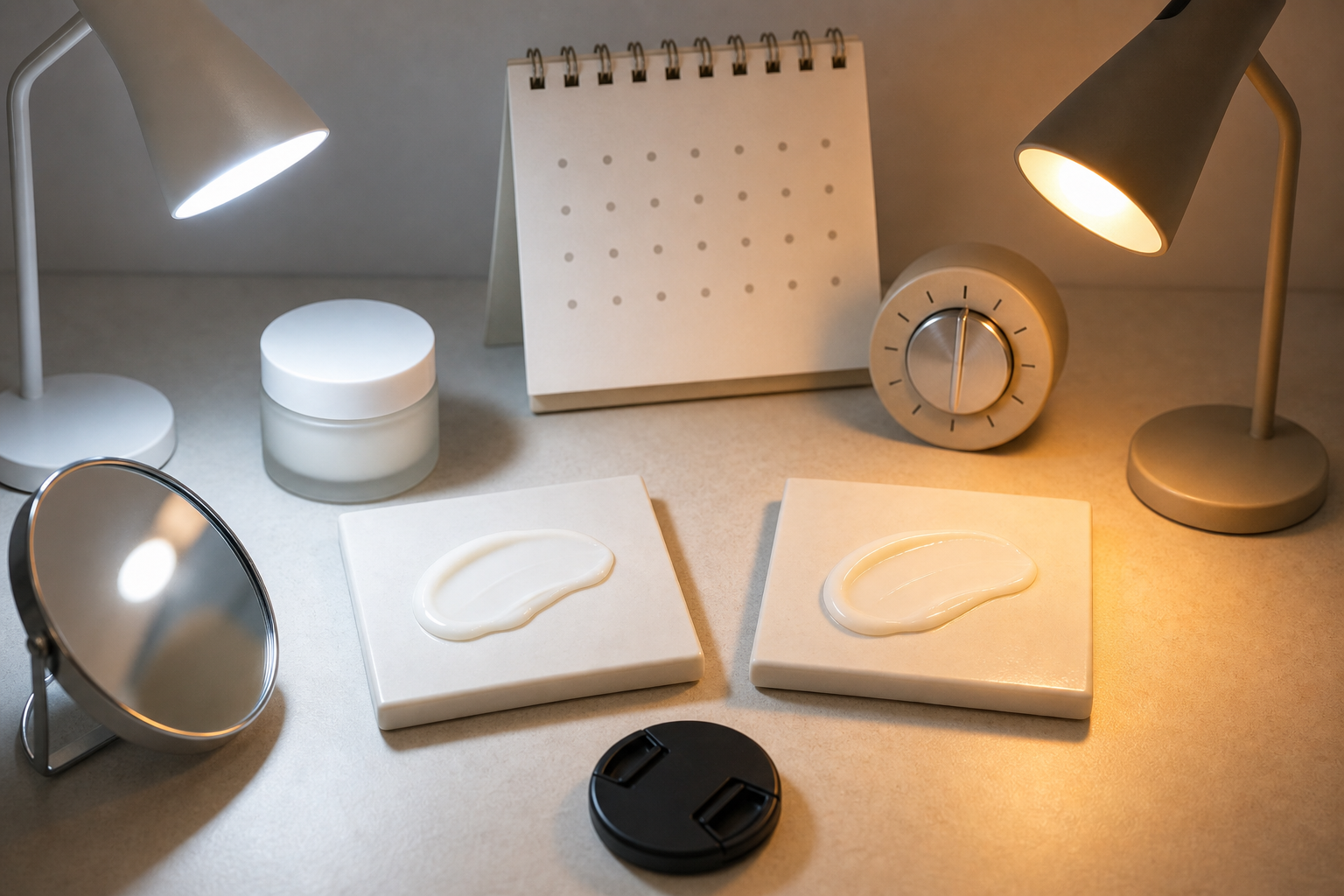
Before-and-after photos are often affected by lighting, angle, camera settings, skin preparation, makeup, exposure, and editing. Even honest reviewers can accidentally make results look more dramatic by changing lighting.
Look for consistent lighting, similar angles, no obvious filters, and close-up honesty. Be cautious with photos where the before is dull and shadowy while the after is bright and warm.
Your skin should not have to compete with a ring light.
Sponsored does not mean useless
Sponsored reviews can still be informative, but you should read them differently. The reviewer may genuinely like the product, but the content exists as marketing.
Look for specifics. Does the review mention downsides? Does it show texture honestly? Does it discuss who the product may not suit? Does it compare to previous products? Or does it only repeat brand claims?
Specific reviews are more useful than beautiful enthusiasm.
Watch repeated phrases
When many reviews use the same phrases, it may be because the brand provided talking points or because people are repeating trend language. Words like game-changing, glass skin, holy grail, clean, medical-grade, barrier repair, and non-comedogenic can sound convincing without telling you much.
Ask what the product actually did. Did it reduce tightness? Did it pill? Did it sting? Did it leave white cast? Did it break someone out? Did it work under makeup?
Concrete details beat buzzwords.
Negative reviews can be useful
Do not ignore negative reviews. They reveal texture problems, fragrance issues, packaging failures, pilling, white cast, breakouts, irritation, and mismatch.
But read negative reviews with context too. A product may be blamed for a breakout that was already forming. A sunscreen may be called greasy by someone with very oily skin but perfect by someone with dry skin. A retinol may be called terrible by someone who used it nightly from day one.
The best shopping decision comes from patterns, not one dramatic review.
Look for repeated patterns
If many people mention the same issue, pay attention. Repeated comments about eye sting, white cast, strong fragrance, pilling, heavy texture, leaking packaging, or fast oxidation matter.
If only one person mentions a problem, it may still be real for them, but it may not predict your experience.
Patterns are more useful than extremes.
Ingredient lists need context
Ingredient lists are useful, but they do not tell the whole story. Concentration, formula structure, pH, packaging, and how ingredients interact all matter.
Do not buy only because one famous ingredient appears. Do not reject automatically because one ingredient sounds scary without context.
For sensitive or acne-prone skin, ingredient awareness helps, but formula experience still matters.
Viral products are not automatically better
A product can go viral because it is genuinely good, visually satisfying, heavily seeded to creators, affordable, controversial, beautifully packaged, or simply lucky.
Viral attention increases visibility, not suitability.
Before buying, ask whether the product fits your routine, skin type, climate, budget, and actual concern. If not, enjoying the content may be enough.
Check whether the review shows the boring parts
The most useful reviews often show boring details: how much product was used, how it looks after ten minutes, whether it pills, whether fragrance lingers, whether packaging leaks, whether it stings the eyes, and whether it works with sunscreen or makeup.
Polished reviews may show the exciting opening moment but skip daily annoyances. Daily annoyances decide whether you repurchase.
If a review only shows the product being applied beautifully once, treat it as an impression, not a full verdict.
Decide before you add to cart
Before buying from reviews, decide your reason. Are you replacing an empty product, solving a specific concern, testing a new category, or shopping because the content made you excited?
Excitement is not wrong. But if the product does not fit your skin type, routine, budget, or main concern, wait. Put it on a wishlist and see whether you still want it next week.
The pause is powerful. Many hype purchases fade once the algorithm stops showing the same product every day.
The practical view
Beauty reviews are useful when read critically. Match skin type. Check the use case. Question instant miracles. Look at timelines. Watch lighting. Read sponsored content for specifics. Notice repeated patterns. Compare both positive and negative reviews.
The goal is not to distrust everyone. It is to separate helpful experience from hype.
A good review should make you a smarter shopper, not just a faster buyer.