K-Beauty and J-Beauty in Singapore: Why the Textures Work, and Where to Be Careful
K-beauty and J-beauty often fit Singapore routines because the textures are wearable, but country-of-origin is not a substitute for formula judgement.
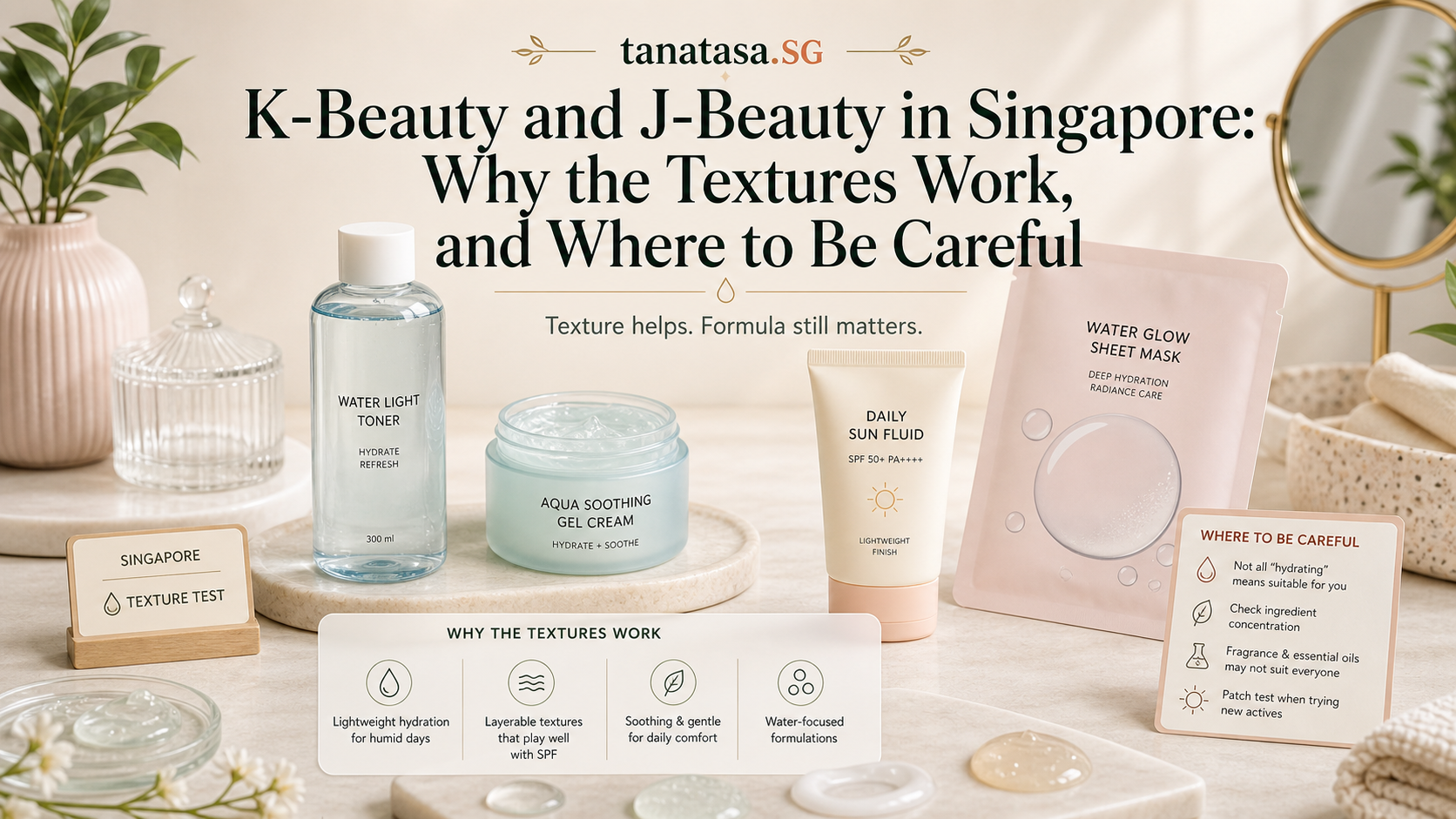
K-beauty and J-beauty are popular in Singapore for reasons that are more practical than hype. Many products feel light, layerable, and easy to wear daily. Sunscreens can be elegant. Hydrating toners do not always feel sticky. Gel creams can moisturise without the heavy finish some people dislike. Cleansers often sit in that useful zone between gentle and effective.
That practical fit matters. A product that feels good enough to use consistently is more valuable than a technically impressive product you avoid every morning.
But "K-beauty" and "J-beauty" are retail categories, not quality guarantees. They contain excellent products, average products, unsuitable products, fragranced products, strong actives, gentle basics, viral disappointments, and quiet staples. The country label can help you navigate texture expectations, but it should not replace formula judgement.
Why The Textures Often Work
Many Korean and Japanese skincare products are designed around elegant daily use: watery lotions, essences, gel creams, milk sunscreens, lightweight emulsions, and layering-friendly textures. That makes them attractive for people who dislike heavy creams or greasy sunscreen.
In a Singapore routine, this can be genuinely useful. If a moisturiser is too rich, people use less or skip it. If sunscreen feels sticky, people under-apply. If a hydrating step feels heavy, it becomes clutter. Lightweight textures can make basic habits easier to maintain.
This is especially true for:
Daily sunscreen.
Hydrating toner or lotion.
Lightweight moisturiser.
Gentle cleanser.
Barrier-support serum.
Non-greasy body sunscreen or hand cream.
The best versions make the routine easier without encouraging unnecessary steps.
Layering Is Useful Only When Each Layer Has A Job
K-beauty is often associated with multi-step routines. That can be helpful when steps are chosen carefully. It can also become a way to buy more products than the skin needs.
A routine does not become better just because it has more layers. A hydrating toner, serum, moisturiser, and sunscreen can make sense if your skin needs hydration and the textures layer well. But if the toner, essence, ampoule, serum, and cream all promise "glow" without a clear difference in function, you may simply be adding cost and irritation risk.
Think by job:
Cleanse.
Hydrate.
Moisturise.
Protect.
Treat one or two concerns.
If a product does not have a job, it is optional. Optional is fine, but it should not be confused with necessary.
J-Beauty Often Wins On Everyday Simplicity
Japanese skincare is often associated with practical daily categories: cleansing oils, gentle foaming cleansers, watery lotions, milky emulsions, sunscreens, and body-care basics. Many products are designed for regular use rather than dramatic transformation.
This can be a good fit for people who want a simpler routine. A Japanese lotion plus moisturiser plus sunscreen may be enough for many daily routines. The appeal is not that the product is Japanese. The appeal is that the format solves a routine problem.
As with any category, still check fragrance, alcohol, texture, and whether the product suits your skin. A famous Japanese sunscreen may feel beautiful for one person and sting another person's eyes.
K-Beauty Often Wins On Variety And Soothing Categories
Korean skincare has a wide range of hydrating, soothing, barrier, and texture-focused products. Centella, panthenol, mugwort, snail mucin, heartleaf, ceramides, rice, propolis, and fermented ingredients appear often across K-beauty shelves.
Some of these products can be very helpful, especially when the formula is well designed. But ingredient popularity should not become ingredient collecting. You do not need one serum for every botanical you have heard of.
Also, soothing is not the same as irritation-proof. A product marketed as calming can still contain fragrance, essential oils, exfoliating acids, or ingredients your skin dislikes. If your skin is reactive, read beyond the calming theme.
Sunscreens Are A Major Reason People Shop These Categories
Korean and Japanese sunscreens are popular because many feel elegant enough for daily use. Lightweight gels, essences, milks, and watery lotions can make sunscreen feel less like a chore.
The practical benefit is real: if a sunscreen feels comfortable, people apply it more willingly. But do not judge sunscreen only by elegance. Check UVA/UVB protection, seller reliability, expiry, and whether the product suits your day. A lightweight daily sunscreen may be perfect for commuting and office life but less suitable for swimming or long outdoor activity unless the label supports that use.
Parallel imports are common in this category. That does not make them bad. It does mean you should know which version you are buying and whether the listing is clear.
Watch For Fragrance And Essential Oils
Many K-beauty and J-beauty products are fragrance-free or low-fragrance, but many are not. Scented products can be enjoyable if your skin tolerates them. The issue is troubleshooting.
If your skin is calm, fragrance may not be a problem for you. If you are dealing with eczema-prone skin, barrier irritation, post-treatment sensitivity, or repeated unexplained stinging, fragrance-free products make the routine easier to evaluate.
Do not assume botanical scent is automatically gentler. Natural fragrance components and essential oils can still irritate some skin.
Be Careful With Viral Actives
K-beauty and J-beauty are not only gentle hydration. There are exfoliating pads, retinoids, vitamin C products, peeling gels, brightening serums, pore treatments, and acne products. Viral formats can make strong products look cute and harmless.
Treat actives by their function, not their packaging style. A toner pad can still exfoliate strongly. A serum in a pastel bottle can still irritate. A brightening product can still be too much if layered with retinol and acids.
Introduce one active at a time. Keep the rest of the routine stable. This advice is boring because it keeps being useful.
Authenticity, Expiry, And Versions Matter
Because demand is high, K-beauty and J-beauty products often appear across official stores, authorised retailers, parallel importers, resellers, and marketplace sellers. The same product may have different packaging across markets or reformulations over time.
Before buying, check:
Is this the official local version or an imported version?
Is the seller reliable?
Is the expiry date reasonable?
Does the listing show the exact variant?
Are reviews about the product or only delivery speed?
Is the price difference explained?
This is not special suspicion toward these categories. It is normal marketplace hygiene.
Build A Routine, Not A Theme
A good routine can include Korean products, Japanese products, European pharmacy products, local brands, American products, and simple no-hype basics. Your skin does not know the shelf category. It responds to the formula.
If a K-beauty toner hydrates well, keep it. If a Japanese sunscreen makes you apply enough, keep it. If a pharmacy moisturiser works better than both, keep that. The goal is not a themed routine. The goal is a routine that works.
Bottom Line
K-beauty and J-beauty often fit Singapore routines because many textures are wearable, light, and easy to repeat. That is a real advantage. But country-of-origin is only a clue, not proof.
Judge the product by function, formula, texture, seller reliability, expiry, and how it behaves on your skin. The best routine is not the most aesthetically coherent one. It is the one you can use consistently without overbuying, over-layering, or over-trusting a label.


