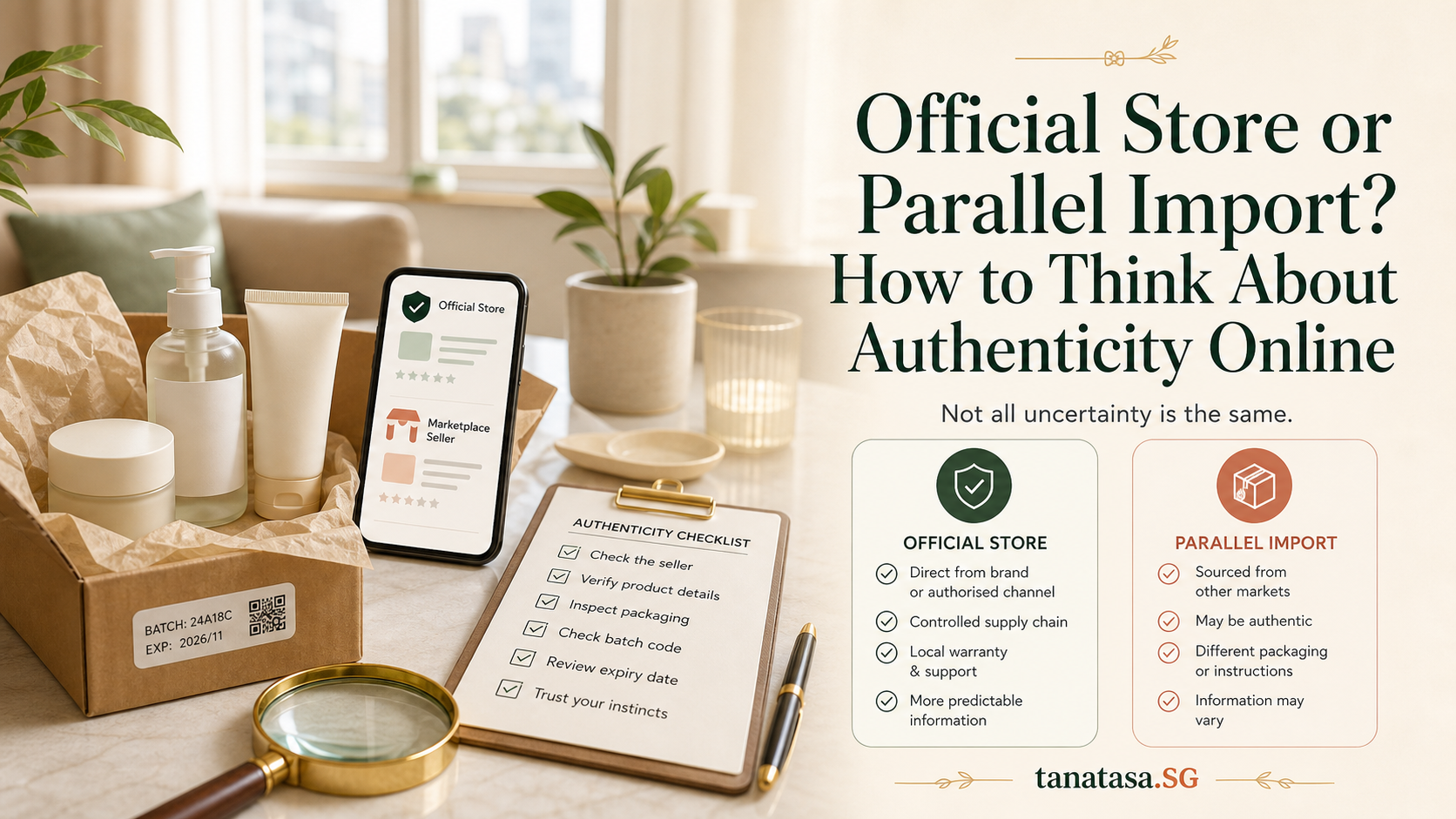
Official Store or Parallel Import? How to Think About Authenticity Online
Parallel imports are not automatically fake, official stores are not automatically the best value, and skincare authenticity online is really about how much uncertainty you are willing to accept.
Online beauty shopping in Singapore often comes down to a familiar choice: buy from the official store at a higher price, or buy from another seller with a better deal. The debate usually becomes too simple. Official store sounds safe. Parallel import sounds suspicious. Third-party seller sounds like a gamble.
Real shopping is more mixed than that.
An official store can be the best choice when you want certainty, support, current local packaging, and fewer questions. A parallel import can be genuine and fairly priced. A third-party seller can be careful and reliable. A very polished listing can still hide weak details. The useful question is not "which channel is morally better?" The useful question is: what uncertainty am I accepting, and is the discount worth it for this product?
Start With The Product Category
Not every beauty product deserves the same level of caution. A body wash from a reputable seller is a different decision from sunscreen for daily use. A hand cream is different from a retinol serum. A lip tint is different from baby eczema care.
For low-risk, familiar products, a good third-party or parallel import listing may be perfectly reasonable if the product details are clear. For high-trust categories, official or authorised channels often make more sense.
Higher-trust categories include:
Sunscreen, because storage, authenticity, and formula confidence matter.
Baby and pregnancy-related products, because uncertainty feels less acceptable.
Eye-area products, because irritation consequences can be more serious.
Retinoids, exfoliating acids, vitamin C, and other actives, because misuse already carries irritation risk.
Expensive prestige products, because counterfeiting and disappointment cost more.
Products for compromised or eczema-prone skin, because a bad reaction is not just inconvenient.
This is not about being paranoid. It is about matching the level of checking to the category.
What Official Stores Are Really Selling
An official store is not only selling the product. It is selling lower uncertainty. You are usually getting the brand's intended assortment for that market, current campaigns, official bundles, customer support, clearer return routes, and less worry about whether the item is genuine.
That certainty is valuable when the product is new, expensive, often counterfeited, or used in a sensitive routine. It is also useful when you need the exact local version because ingredients, labelling, or packaging may differ across markets.
But official store does not mean every purchase is automatically smart. Official bundles can encourage overbuying. Gift-with-purchase mechanics can make you spend more than planned. A prestige product can still be unsuitable for your skin. The official channel reduces source uncertainty; it does not replace routine judgement.
The best use of official stores is selective. Pay for certainty when certainty matters. Do not pay for a bigger cart just because the store knows how to make bundles feel urgent.
Authorised Sellers Sit Close To Official
Authorised retailers and distributors can offer a useful middle ground. They may not be the brand's own store, but they have a formal supply relationship and often clearer accountability than a random marketplace seller.
In Singapore, this category can include established retailers, pharmacy chains, beauty chains, department-store counters, and recognised online stores. When an authorised seller is clear about product source, size, expiry, and return path, the shopping experience can be almost as reassuring as official, sometimes with better promotions.
The word "authorised" should still be specific. A seller should not just throw it into a product title like decoration. If the claim matters to your decision, look for signs that the store is established, reachable, and consistent across its product listings.
Parallel Import Does Not Mean Fake
Parallel imports are genuine products brought in through channels outside the brand's local authorised distribution. That can mean a Japanese version, Korean version, US version, European version, or another regional version showing up on a Singapore marketplace.
There are many legitimate reasons parallel imports exist: price differences between markets, stock availability, different pack sizes, overseas promotions, or consumer demand for products not officially sold here.
The issue is not authenticity alone. The issue is information. A parallel import may have:
Different packaging or language.
Different ingredient list or concentration.
Different texture or fragrance profile.
Different expiry or batch coding format.
Different regulatory labelling.
Different customer support if something goes wrong.
Sometimes those differences do not matter much. Sometimes they matter a lot. A shopper who buys a parallel import should know what version they are buying, not discover it only when the parcel arrives.
Packaging Differences Need Context
Packaging changes are common in beauty. Brands refresh labels, change bottle shapes, update ingredient names, alter regional packaging, and move from old to new designs. A different-looking product is not automatically fake.
But the seller should help you understand the difference. "New packaging" or "Japan version" or "US packaging" is useful. One generic image across multiple variants is not. A listing that shows one bottle, describes another, and sends a third is asking the customer to carry too much uncertainty.
When packaging matters, compare more than the front image. Check size, full product name, variant, ingredient list if available, batch or expiry context, and seller reviews mentioning the exact product. Reviews that only say "fast delivery" are nice, but they do not answer authenticity questions.
Price Should Have A Story
A lower price can be completely normal. Marketplaces run campaigns, sellers clear stock, exchange rates move, and overseas pack sizes can be cheaper. The red flag is not discount by itself. The red flag is a discount with no explanation.
Ask what explains the price:
Is it short-expiry stock?
Is it older packaging?
Is it a smaller size?
Is it a bundle split?
Is it a tester, refill, or no-box item?
Is it an overseas version?
Is it a seller trying to build volume during a campaign?
If the listing answers clearly, you can decide. If the listing does not answer and the price is far below the usual range, the product may still be genuine, but your uncertainty has gone up.
For skincare, the cheapest option is not always the best value. A questionable product you stop using after two applications is more expensive than a slightly pricier product you trust and finish.
Expiry Is Not A Small Detail
Expiry and period-after-opening matter more for some products than others. Sunscreen, vitamin C, retinoids, eye products, baby care, and products used on irritated skin deserve more attention. Short-expiry stock can be good value if it is clearly labelled and you can finish it comfortably. It is a poor deal if it pressures you to overuse an active or stockpile something you barely know.
For online purchases, the listing should be clear when expiry is unusually soon. If the seller only reveals it after delivery or in a tiny image that is easy to miss, that is not customer-friendly.
Storage also matters. Singapore parcels may sit in warm vans, lockers, or doorways. Most cosmetics tolerate ordinary shipping, but heat-sensitive products, sunscreen, and unstable actives deserve a little more caution. A seller who moves stock properly and does not leave you guessing is worth something.
When To Pay More For Certainty
Paying more can be sensible when:
You are buying sunscreen for daily use.
The product is for a baby, pregnancy, or compromised skin.
You are buying a strong active for the first time.
The product is expensive or often counterfeited.
You need the exact local version.
You want a clear return or support route.
The cheaper listing is vague about expiry, source, or variant.
Paying less can be sensible when:
You already know the product well.
The seller is reputable and specific.
The variant and size are clear.
The discount has an obvious explanation.
The product is lower risk.
You are comfortable with an overseas version.
The best decision is not always the most cautious one. It is the one where the risk level matches the product and the savings.
A Simple Listing Audit
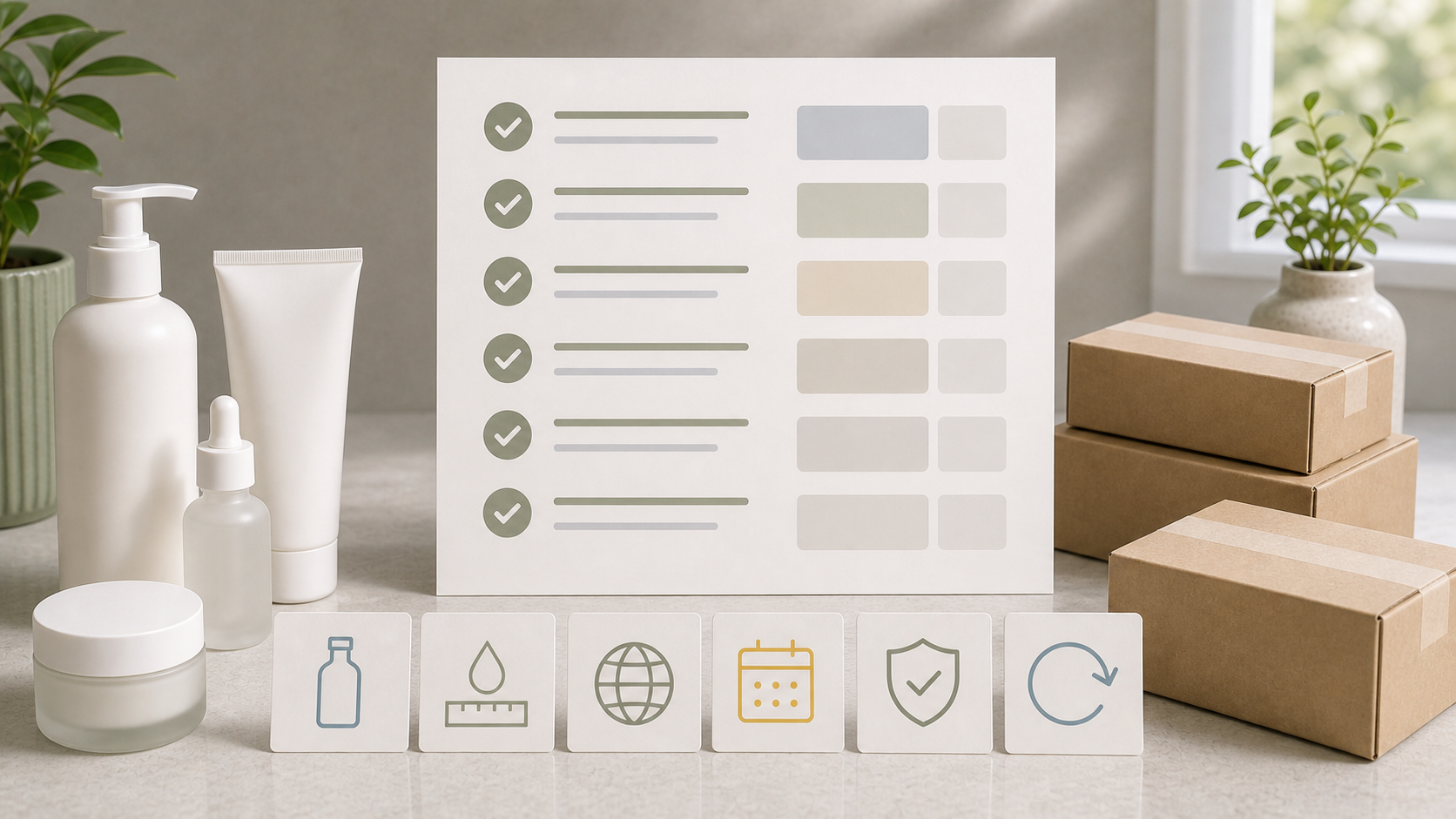
Before buying from a non-official listing, check:
Product name: is it exact or generic?
Variant: does the selected option match the image?
Size: are you comparing the same ml or g?
Version: local, Japan, Korea, US, Europe, or unspecified?
Expiry: shown, stated, or hidden?
Seller: official, authorised, reputable third-party, or unclear?
Reviews: do they mention product condition, not just delivery speed?
Return path: what happens if the product arrives wrong?
You do not need to do all this for every lip balm. But for products that matter to your skin health or cost more money, the audit pays for itself.
Bottom Line
Authenticity shopping is not about assuming everyone online is suspicious. It is about knowing where uncertainty enters the purchase.
Official stores sell lower uncertainty. Authorised sellers can be a strong middle ground. Parallel imports can be genuine and worthwhile when the listing is clear. Third-party sellers can be fine when they earn trust through details, consistency, and accountability.
The question is not whether official is always best or parallel import is always risky. The question is whether you understand what you are buying, who is selling it, why the price is what it is, and whether that level of uncertainty is acceptable for the product you are putting on your skin.