Daily Sunscreen in Singapore: How to Choose One You Will Actually Use
A practical Singapore sunscreen guide covering UV exposure year-round, how to read SPF and UVA labels, choosing the right texture for humid weather, and how to build a reapplication habit that actually works.

Singapore is one of the most UV-intense places in the world to live. The country sits just 1.3 degrees north of the equator, meaning the sun is close to directly overhead for much of the year. UV index levels regularly reach 10 or above - the very high to extreme range - and this happens on overcast days too, not just clear ones. UV passes through cloud cover more effectively than most people expect.
This matters because UV damage is cumulative. It builds up over years of daily exposure: the walk to the bus stop, the lunch errand, the school run, the Saturday market. Most of this happens without anyone thinking of it as sun exposure in the deliberate sense. But your skin is accumulating it regardless.
The goal of this guide is not to make sunscreen feel complicated. It is the opposite. The best sunscreen is the one you use consistently, apply in enough quantity, and can actually reapply during the day. Everything else - the SPF number, the formula type, the brand - comes second to those three things.

Understanding the labels: what SPF and UVA ratings actually mean
Before choosing a sunscreen, it helps to understand what the numbers and symbols on the label are measuring - because they are measuring different things.
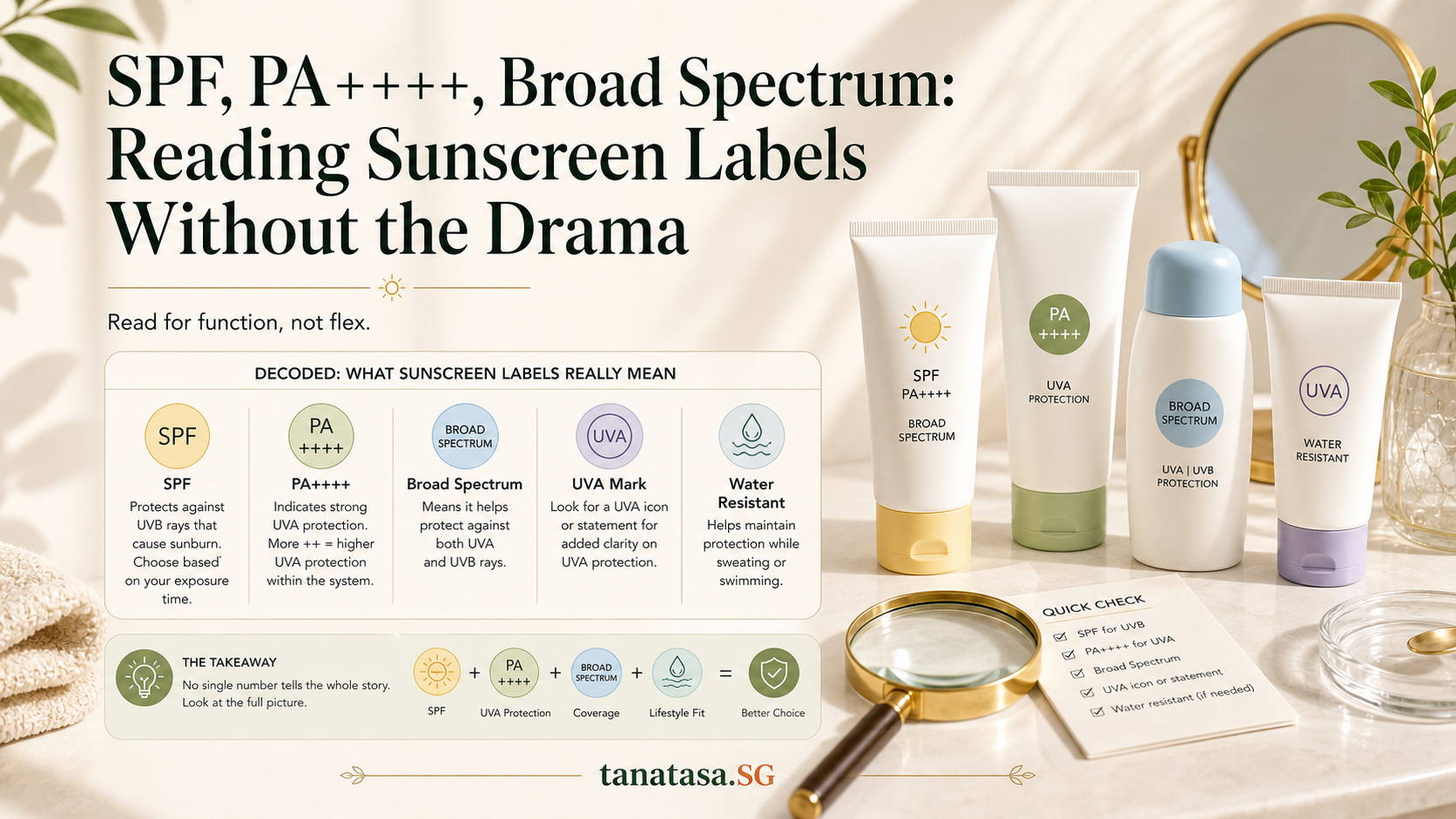
SPF - UVB protection
SPF stands for Sun Protection Factor. It measures protection against UVB rays, which are the rays primarily responsible for sunburn and are also linked to skin cancer risk. The number tells you roughly how much longer you can stay in the sun before your skin starts to burn, compared to having no protection at all.
SPF 30 blocks about 97% of UVB rays. SPF 50 blocks about 98%. SPF 100 blocks about 99%. The differences between higher numbers are smaller than the marketing suggests, but SPF 50 is a reasonable baseline for Singapore conditions, especially for anyone spending meaningful time outdoors.
The important caveat: SPF is measured in a lab using 2mg of product per square centimetre of skin. Most people apply about a quarter of that in real life. Under-application significantly reduces effective protection. Two fingers of sunscreen for the face and neck is the commonly recommended quantity.
UVA protection - the ratings you will see on different products
UVB protection (the SPF number) is only part of the story. UVA rays penetrate more deeply into the skin and are primarily responsible for long-term skin ageing and pigmentation changes. UVA protection is where labels become more varied, because different markets use different rating systems.
PA System (PA+ to PA++++): Common on Japanese and Korean sunscreens, this system is based on PPD - Persistent Pigment Darkening - which measures how long it takes for skin to tan with sunscreen versus without. PA+ offers some UVA protection, and each additional + represents a higher level. PA++++ is the highest rating and corresponds to a PPD of 16 or higher.
PPD (Persistent Pigment Darkening): The clinical measurement behind the PA system. A PPD of 10 means it takes 10 times longer for your skin to tan with the sunscreen than without. This appears as a standalone number on some European products.
Broad Spectrum (US standard): A label used in the United States confirming that the sunscreen meets the FDA ratio requirement for UVA versus UVB protection. It does not tell you how much UVA protection you are getting - only that the ratio passes a minimum threshold.
UVA Seal (EU standard): A circle logo with UVA inside it, used on products sold in Europe. It indicates that UVA protection is at least one-third of the labelled SPF. A sunscreen with SPF 50 and the UVA seal provides at least the equivalent of SPF 17 in UVA protection.
Boots Star Rating (0-5 stars): Developed in the UK, this rates the ratio of UVA to UVB protection. Five stars means very balanced protection across the spectrum. This appears mostly on UK-market products.
In Singapore, most sunscreens are labelled with SPF. Japanese and Korean products will often also carry a PA rating. Western products tend to use Broad Spectrum or the UVA seal. None of these systems is inherently better - they just measure different things. For everyday Singapore use, an SPF 50 sunscreen is a sound baseline. A PA rating is a useful bonus if the product carries one.
Chemical, physical, and hybrid filters - what the difference feels like
Sunscreen filters fall into two broad categories: chemical (also called organic) and physical (also called mineral or inorganic). Many modern sunscreens use a combination of both.
Chemical filters
Chemical filters work by absorbing UV energy and converting it to heat, which is then released from the skin. Common chemical filters include avobenzone, octinoxate, homosalate, oxybenzone, and newer-generation filters like Tinosorb S and Tinosorb M, which are more common in European and Asian formulations.
In terms of feel, chemical filters tend to be lighter and more cosmetically elegant. They are easier to formulate into thin fluids, gels, and serums. They blend into skin without a white cast. For humid Singapore weather, where a heavy or sticky product is likely to be abandoned, chemical-filter sunscreens are often more practical to use.
The tradeoff: some chemical filters (particularly oxybenzone) have been associated with skin sensitivity in some people. Newer-generation filters are generally considered more stable and less sensitising, but formulations vary.
Physical (mineral) filters
Physical filters - zinc oxide and titanium dioxide - work by sitting on the surface of the skin and reflecting UV rays. They tend to be more suitable for people with sensitive or reactive skin because they are less likely to cause irritation.
The limitation in a humid climate: mineral filters, especially in higher concentrations, often leave a white or greyish cast on the skin. This is more noticeable on deeper skin tones and in formulas that are not carefully engineered. Some micronised or tinted mineral formulas have largely addressed this, but it is worth patch-testing before committing.
Mineral sunscreens can also feel thicker and require more blending. In Singapore heat, this can be uncomfortable for some people.
Hybrid formulas
Most contemporary sunscreens are hybrid - they combine chemical and mineral filters to balance protection, stability, and skin feel. These tend to offer good broad-spectrum coverage while being more wearable than a purely mineral formula. For most people in Singapore, a well-formulated hybrid is the practical sweet spot.

Texture and format: choosing what you will actually wear
Texture is the most underrated factor in sunscreen compliance. A sunscreen that feels wrong will be applied sparingly, avoided on some days, or abandoned within weeks. Choosing by texture is not vanity - it is effectiveness.
Fluid and lotion
The most common format. A well-formulated fluid sunscreen can feel almost like a lightweight moisturiser. Good for everyday use and most skin types. Look for ones that dry to a matte or satin finish if you have oily skin, or a more luminous finish if you prefer that look.
Gel
Water-based gel formulas tend to feel very light and cooling on application. They absorb quickly and are particularly popular with oily or acne-prone skin. The tradeoff is that some gel formulas are not as water-resistant, so they may need more frequent reapplication if you are sweating.
Stick
Compact, easy to carry, and excellent for reapplication without disturbing makeup or creating mess. Stick sunscreens are ideal as a midday touch-up format. They are not always the most practical as a base layer (coverage can be uneven), but as a secondary application tool they are very useful.
Cushion and compact
Popular in Korean beauty routines, cushion sunscreens offer a hybrid of sunscreen and light coverage. Convenient for reapplication in public. SPF levels vary, so check the label carefully - some cushion products have lower SPF than their standalone sunscreen counterparts.
Moisturiser with SPF
A single product that combines moisturiser and sun protection. Reduces the number of steps in a routine, which some people find makes the habit easier to maintain. The tradeoff is that SPF levels in combined products can be lower, and the amount you apply of a moisturiser is typically less than you would apply of a dedicated sunscreen.

The reapplication problem - and practical solutions
SPF degrades with exposure. Sweating, touching your face, blotting with tissue, and time all reduce the effectiveness of sunscreen already on your skin. The general recommendation is to reapply every two hours during sun exposure.
In Singapore, where most people move between air-conditioned and outdoor environments multiple times a day, the practical question is not just how to reapply - it is when.
A useful framework: reapply any time you are about to have extended outdoor exposure. Before a lunch walk. Before leaving the office. Before a school pickup. You do not need to be rigid about two-hour intervals - but you do need to reapply when the situation changes.
For reapplication, the format matters. Full liquid sunscreen reapplied over makeup is awkward. This is where stick sunscreens, cushion compacts, and SPF-infused setting sprays become useful - they exist specifically to solve the reapplication problem. Keep one in your bag. Make it as frictionless as possible.
Sunscreen for different skin types
Oily and acne-prone skin
Look for non-comedogenic formulas (though this label is not regulated, user reviews and patch testing are more reliable). Gel or water-based fluid textures tend to work better than cream formulas. Avoid anything described as dewy or luminous if you are already oily. A matte or satin finish will be more comfortable through the day.
Some people with acne-prone skin find that switching to a better-suited sunscreen significantly reduces breakouts - because they were previously avoiding sunscreen entirely or using one that was congesting their pores.
Dry skin
Cream and lotion formulas with added humectants (like glycerin or hyaluronic acid) or emollients will provide more comfortable wear. Avoid gel formulas, which can feel drying. A moisturiser-with-SPF format works well here as a combined step.
Sensitive and redness-prone skin
Mineral or hybrid formulas with a short, simple ingredient list. Avoid fragranced sunscreens - fragrance is one of the more common sensitisers in skincare. Avoid sunscreens with high concentrations of alcohol, which can be drying and irritating. Look for calming ingredients like centella asiatica or niacinamide if your skin reacts easily.
Deeper skin tones
The white cast from mineral filters is most visible on deeper skin tones. Chemical or hybrid formulas with small amounts of zinc or titanium dioxide, or tinted formulas, tend to work better. UVA protection is worth paying attention to here because UVA rays are directly linked to pigmentation concerns.
Do you need sunscreen indoors?
Glass blocks most UVB rays but transmits a significant portion of UVA. If you sit near a window, drive regularly, or work in a space with significant natural light, you are receiving UVA exposure even indoors. This is relevant particularly for pigmentation, which is primarily UVA-driven.
The practical answer: if you sit away from windows and have minimal glass exposure, daily SPF is still a good habit because of incidental outdoor exposure during commuting and errands. If you sit near windows, SPF indoors is more clearly warranted. You do not need a different sunscreen for indoors - your regular SPF 50 is fine.
Common questions
Can I use body sunscreen on my face?
Body sunscreens tend to be formulated for thicker, less reactive skin. They often contain higher concentrations of filters and may be more occlusive. For everyday facial use, a face-specific sunscreen is more likely to sit comfortably under makeup and feel good on the skin. For occasional use - at the beach, when you run out - body sunscreen on your face is not harmful but may not be ideal.
Does sunscreen expire?
Yes. The SPF rating of expired sunscreen cannot be guaranteed. Check the PAO (period after opening) symbol on the packaging - a small open jar icon with a number, indicating how many months the product remains effective after opening. For sunscreens, this is typically 12 months. Keep sunscreens away from heat, which accelerates degradation, and replace them if they have separated, changed smell, or changed texture.
Why do some Asian sunscreens not say Broad Spectrum?
Broad Spectrum is a US FDA label. It is not required or used in Japan, Korea, or many other markets. The absence of this label does not mean the product lacks UVA protection - it may simply be sold under a different regulatory framework. Check the PA rating or look for the UVA seal if you want to assess UVA coverage on non-US products.
My sunscreen pills under makeup. What should I do?
Pilling usually happens when layers are applied too quickly, when incompatible silicone-based products are layered, or when the sunscreen formula does not play well with the primer or foundation. Try waiting 2-3 minutes for sunscreen to fully absorb before applying makeup. Switching to a more fluid, faster-absorbing sunscreen formula often solves the problem.
Do I need to reapply indoors?
If you are staying indoors away from windows for the rest of the day, reapplication matters less. If you will have any outdoor exposure, or sit near windows, reapplication remains relevant. Once every two hours during outdoor exposure is the general guideline.
Building the habit
The most effective sunscreen routine is a simple one. One product you like, applied as part of a morning routine you already have, with a reapplication option in your bag.
Start there. Do not optimise for maximum SPF or the most sophisticated formula if it means you use it inconsistently. Consistency at SPF 30 beats occasional use at SPF 100.
Singapore UV is not going anywhere. The investment in a daily sunscreen habit - maintained over years - is one of the more meaningful things you can do for your skin long-term.