SPF, PA++++, Broad Spectrum: Reading Sunscreen Labels Without the Drama
SPF, PA++++, broad spectrum, UVA circles, water resistance, and imported sunscreen labels are easier to read once you know what question each label is trying to answer.
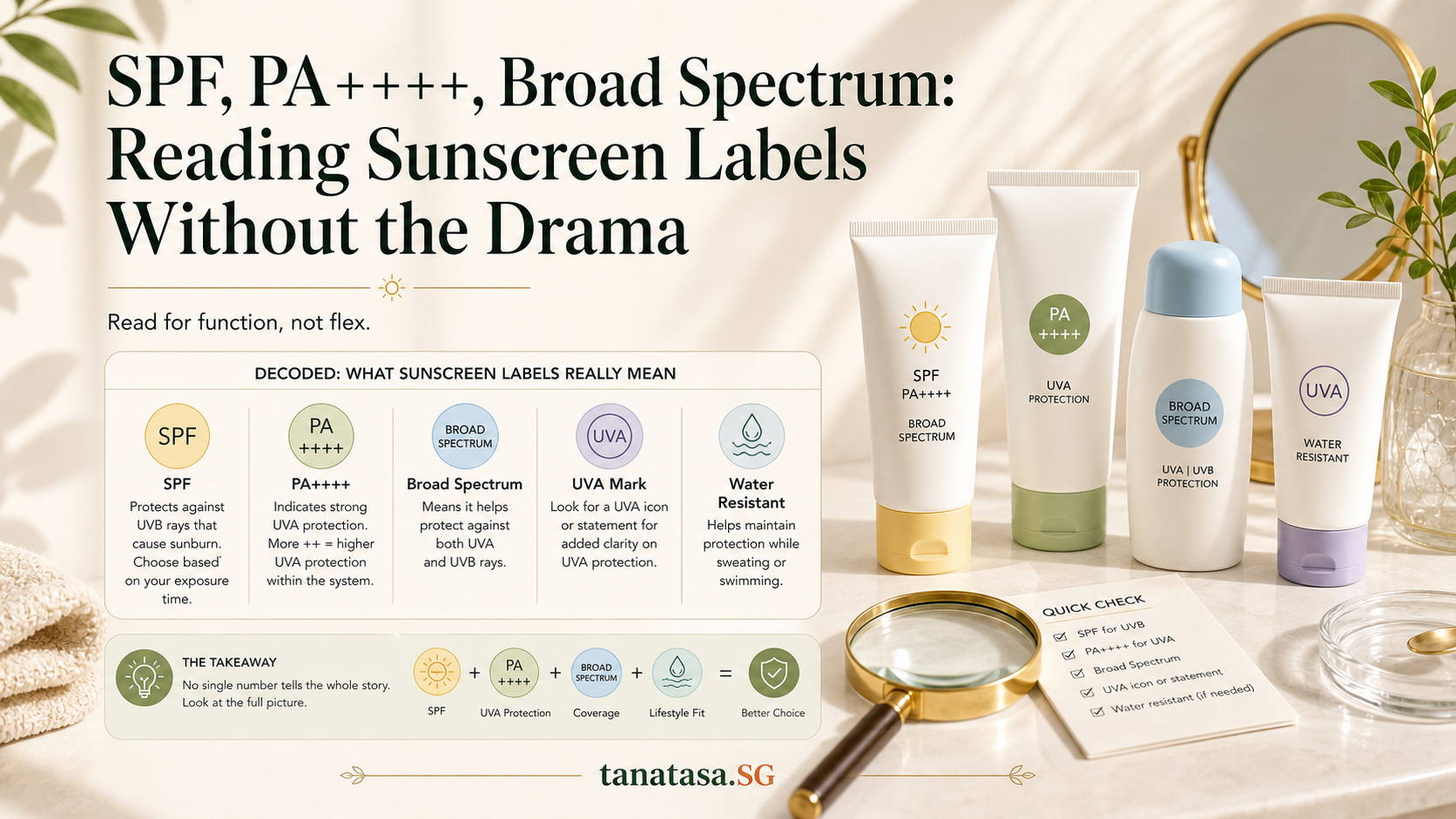
Sunscreen labels can feel like a small exam: SPF50, PA++++, broad spectrum, UVA circle, water resistant, mineral, chemical, hybrid, reef-safe, blue-light protection, sweat-resistant, tone-up, gel, milk, essence. Singapore shelves make this more confusing because products arrive from many markets: Japan, Korea, Australia, Europe, the US, local distributors, official stores, and parallel import sellers.
The solution is not to memorise every symbol. The useful move is to understand what question each label is trying to answer.
A sunscreen label should help you answer three practical questions: does it protect against the right types of UV, will I apply enough of it, and does it suit the day I am about to have?

SPF Mainly Talks About UVB
SPF stands for sun protection factor. In everyday shopper language, SPF mainly relates to protection against UVB, the part of ultraviolet exposure most associated with sunburn.
Higher SPF can be useful, especially when the day includes outdoor exposure, sweating, water, or long commutes on foot. But the SPF number is not a magic shield. It assumes proper application under testing conditions. If you apply too little, miss areas, or avoid reapplication when needed, the real protection is lower than the label suggests.
This is why a comfortable SPF50 that you apply generously is usually more useful than a beautiful high-number sunscreen you use in a tiny pea-sized amount because it feels expensive or heavy.
UVA Protection Needs Its Own Attention
UVA is linked to tanning, pigmentation, and visible skin ageing, and it can pass through some window glass. This is why broad protection matters. Different markets show UVA protection in different ways.
You may see PA ratings, such as PA+++ or PA++++, especially on many Asian sunscreens. You may see "broad spectrum" on products from markets that use that claim language. European products may show a UVA circle logo. Some Australian sunscreens use their own regulatory label style. The symbols differ, but the shopper question is the same: does this product protect against both UVA and UVB?
If a sunscreen only shouts about SPF but gives you no confidence on UVA protection, compare carefully. Many reputable products cover both, but the label language may vary by market.
PA++++ Is Useful, Not A Personality Trait
PA++++ has become one of those labels people chase because it looks impressive. It is useful information, but it should not override every other factor.
A PA++++ sunscreen that stings your eyes, leaves a cast you dislike, pills under makeup, or feels so sticky that you under-apply may not be the best sunscreen for you. A slightly different label system can still represent good protection if the product is properly formulated and clearly sold.
The goal is not to collect the most intense-looking symbols. The goal is adequate broad protection used properly.
Broad Spectrum Is The Everyday Shortcut
"Broad spectrum" is helpful because it signals protection across UVA and UVB. For daily use, this is often the simplest phrase to look for if the product is from a market that uses it.
But broad spectrum does not answer everything. It does not tell you whether the sunscreen feels elegant, whether it works under makeup, whether it leaves a cast, whether it stings your eyes, or whether it suits outdoor sweating. You still need to match the product to your routine.
Think of broad spectrum as the baseline, not the final shopping decision.
Water Resistance Is Not All-Day Permission
Water-resistant sunscreen is useful for swimming, sweating, outdoor sports, beach days, and activities where sunscreen is likely to move. It does not mean "apply once and forget". Water-resistant labels usually come with time-based directions and reapplication guidance.
For office days, a highly water-resistant sunscreen may not be necessary if the texture makes you dislike using it. For outdoor days, a beautiful lightweight daily sunscreen may not be enough if it is not built for sweat or water.
This is why many people need more than one sunscreen category: a comfortable daily face sunscreen, and a more robust outdoor or body sunscreen. That is not overcomplication. That is matching the product to the day.
Mineral, Chemical, And Hybrid Are Filter Styles, Not Moral Categories
Mineral sunscreens usually rely on zinc oxide and/or titanium dioxide. Chemical sunscreens use organic UV filters. Hybrid sunscreens combine filter types. All three can be legitimate when properly formulated.
The better question is how the formula behaves. Mineral sunscreens may suit some sensitive-skin users, but can leave a visible white cast or feel thicker. Chemical sunscreens may be lighter and more transparent, but can sting some eyes or irritate some users. Hybrid formulas try to balance benefits, but still vary widely.
Do not choose by filter identity alone. Choose by protection, comfort, skin tone, eye comfort, application amount, and reliability of source.
Imported Sunscreens Need Label Translation, Not Panic
Because Singapore shoppers buy from many markets, you may see label systems that do not match local pharmacy shelves exactly. A Japanese sunscreen may use PA language. A European product may highlight UVA circle information. An Australian product may focus on water resistance and outdoor protection. A US product may say broad spectrum but use a different set of permitted filters.
Different language does not automatically mean better or worse. It means you need to read the label in context. Ask:
What market is this product from?
Does it state UVA and UVB protection clearly?
Is the seller reliable?
Is the product version clear?
Is the expiry reasonable?
Does the sunscreen suit daily use, outdoor use, or both?
Imported sunscreens can be excellent. They can also be confusing if the listing is vague. The issue is clarity.

Texture Decides Real-World Protection
The sunscreen you actually use properly is the one that wins most days. Texture affects how much you apply, whether you reapply, and whether you avoid certain areas.
If a sunscreen feels greasy, you may use less. If it leaves a cast, you may avoid applying enough around the hairline and jaw. If it pills, you may skip it under makeup. If it stings your eyes, you may leave the eye area poorly protected. These are not vanity problems. They affect real-world use.
Test sunscreen in daylight. Bathroom lighting can hide white cast. Check around eyebrows, hairline, beard area, neck, and ears. Try it over your moisturiser and under makeup if that is your normal routine.
Reapplication Is A Day-Based Decision
Not every day needs the same reapplication pattern. If you are mostly indoors, away from windows, and not sweating much, your needs are different from a day of errands, outdoor queues, school sports, cycling, swimming, or walking around at noon.
Reapply when the label says to, especially after sweating, swimming, towelling, or prolonged outdoor exposure. For practical life, keep a format you can tolerate: lotion, stick, spray for body touch-ups where appropriate, cushion, or compact. Just remember that convenience formats still need enough product to matter.
If reapplication is impossible with your makeup, consider planning the day: stronger morning application, hat, shade, sunglasses, or a reapplication format you can live with.
A Simple Shopping Framework
For daily face sunscreen:
Broad UVA and UVB protection.
Comfortable enough to apply generously.
Minimal pilling with your routine.
Acceptable finish on your skin tone.
Reliable seller and clear expiry.
For outdoor sunscreen:
Higher protection.
Water resistance if sweating or swimming.
Larger size if used on body.
Easy reapplication.
Texture that does not make people avoid using enough.
For sensitive skin:
Avoid changing many products at once.
Patch test when sensible.
Watch eye sting and fragrance.
Choose comfort over label impressiveness.
Bottom Line
Sunscreen labels are there to help, not to make the routine feel like a science test. SPF mainly answers a UVB question. PA, broad spectrum, and UVA symbols help answer the UVA question. Water resistance answers an activity question. Texture answers the real-life question: will you use enough?
The best sunscreen for Singapore life is not the one with the most dramatic label. It is the one that gives broad protection, comes from a source you trust, suits the day, and feels comfortable enough that you actually apply it properly.


