Sensitive, Hypoallergenic, Dermatologist-Tested: What These Labels Actually Tell You
Sensitive, hypoallergenic, dermatologist-tested, non-comedogenic, and fragrance-free labels can help you shortlist products, but they are not personal guarantees.
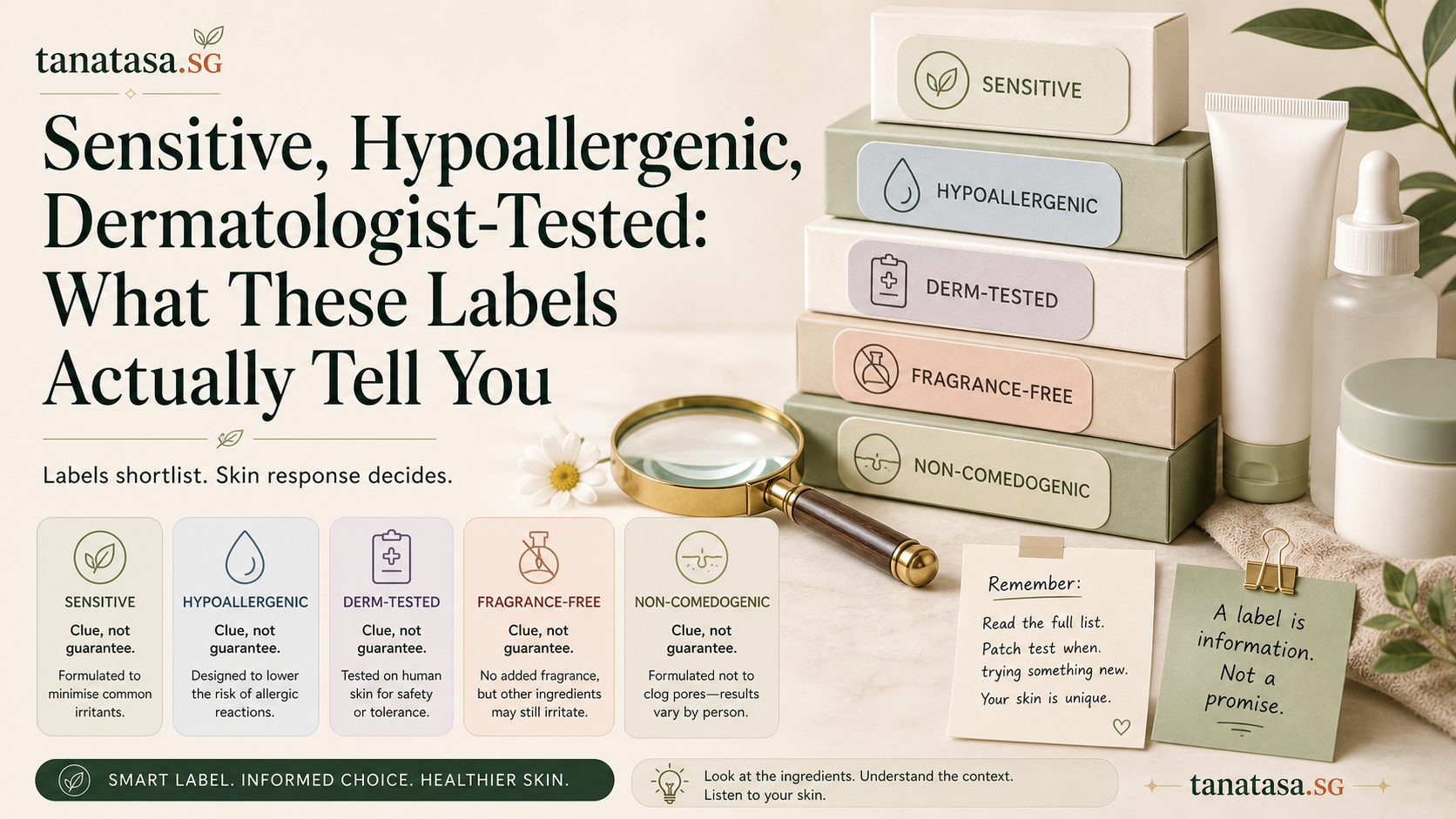
Sensitive-skin labels are useful only when you read them as clues, not promises. "Sensitive", "hypoallergenic", "dermatologist-tested", "allergy-tested", "non-comedogenic", "fragrance-free", and "gentle" all sound reassuring, but they do not all mean the same thing. More importantly, none of them can predict your individual skin response with certainty.
That does not make these labels useless. It means they should be used properly. A label can help you shortlist. Your skin history, ingredient awareness, patch testing, and slow introduction decide whether the product deserves a permanent place in your routine.
This matters in Singapore because shelves and marketplaces carry products from many markets. Claim language can vary by country, brand style, and product category. Some labels are careful. Some are vague. Some are technically true but not very informative.
"Sensitive Skin" Is A Positioning Claim
When a product says it is for sensitive skin, the brand is usually telling you how the product is positioned: simpler, gentler, less fragranced, less harsh, or tested on people who identify as sensitive. That can be helpful, but it is not a regulated magic category that guarantees comfort.
Sensitive skin itself is not one condition. Some people sting easily. Some flush. Some have eczema. Some react to fragrance. Some are acne-prone and irritated from actives. Some are temporarily sensitive after a facial, laser, peel, sun exposure, over-cleansing, or a barrier flare.
A product suitable for one kind of sensitive skin may not suit another. A rich balm may comfort dry eczema-prone skin but clog or feel heavy on acne-prone skin. A light gel may feel elegant but not enough for a damaged barrier. The label is a starting point, not a diagnosis.

Hypoallergenic Does Not Mean Allergy-Proof
"Hypoallergenic" usually means a product is formulated to reduce the likelihood of allergic reactions. It does not mean allergy-proof. People can be allergic or sensitive to ingredients that are safe and well tolerated by most users.
This distinction matters because some shoppers treat hypoallergenic as permission to skip caution. If you have a known allergy, always check the ingredient list. If you repeatedly react around the eyes, lips, neck, or hands, consider professional advice instead of rotating through more hypoallergenic products.
Hypoallergenic is useful when comparing products, especially for baby care, body care, and sensitive-skin routines. But if a product still contains something your skin dislikes, the label will not save it.
Dermatologist-Tested Does Not Tell You The Whole Test
"Dermatologist-tested" sounds strong because a dermatologist was involved in some form of testing or review. The missing details are often the important ones: sample size, skin types tested, test duration, product use conditions, whether sensitive users were included, what result was measured, and whether the test reflects your routine.
This does not mean the claim is fake. It means the claim is incomplete. A dermatologist-tested moisturiser may still sting if your barrier is damaged. A dermatologist-tested sunscreen may still sting your eyes. A dermatologist-tested acne product may still be too drying if you use it daily from the start.
Use the phrase as a confidence signal, not as proof of personal suitability.
Allergy-Tested Is Helpful, But Still Limited
Allergy-tested can suggest the brand has assessed allergy potential, but it does not mean nobody will react. The method matters, and most front labels do not explain the full method.
If you have a history of contact dermatitis, repeated reactions, or suspected ingredient allergy, consumer labels are not enough. Proper patch testing through a healthcare professional may be more useful than guessing from front-of-pack claims.
For everyday shopping, allergy-tested can help narrow choices, especially when combined with fragrance-free, clear ingredient lists, and a simple formula. It should not be read as absolute protection.
Non-Comedogenic Is Not A Universal Acne Guarantee
Non-comedogenic means the product is intended to be less likely to clog pores. That is useful, especially for moisturisers, sunscreens, makeup, and richer creams. But pore-clogging is not determined by one label alone.
It depends on the full formula, how much you apply, your skin type, how well you remove it, what else you layer, and whether your breakouts are actually caused by clogged pores. A non-comedogenic sunscreen can still break someone out. A product without the label can still be perfectly fine.
For acne-prone shoppers, non-comedogenic is a helpful shortlist filter, not a guarantee. Introduce slowly and avoid changing cleanser, moisturiser, sunscreen, and acne treatment all at once. Otherwise you will not know what caused the breakout or irritation.
Fragrance-Free Is More Specific Than Gentle
Fragrance-free usually means fragrance ingredients have not been added for scent. This is a useful label when you are trying to reduce irritation variables, especially for eczema-prone skin, barrier repair, post-treatment skin, baby care, or products used around the eyes and neck.
But fragrance-free does not guarantee a product is gentle in every other way. A fragrance-free acid toner can still irritate. A fragrance-free retinoid can still cause dryness. A fragrance-free sunscreen can still sting.
Also, fragrance-free is not the same as unscented. Unscented products may contain masking fragrance to hide the natural smell of the formula. If fragrance is a concern for you, fragrance-free is usually the clearer term.
"Clean", "Natural", And "Free From" Need Careful Reading
Some sensitive-skin shoppers are drawn to "clean" or "natural" products because they sound safer. Natural origin does not automatically mean lower irritation risk. Essential oils, citrus extracts, botanical fragrance, and plant-derived components can irritate some people.
"Free from" claims can be useful when they match your needs. Free from fragrance, lanolin, essential oils, alcohol, or certain preservatives may matter for some users. But a product being free from one ingredient does not tell you whether the rest of the formula suits you.
Do not let fear-based lists replace calm evaluation. Ingredients are not good or bad just because they sound natural or synthetic. Formula and personal tolerance matter.
What To Do With These Labels In Real Life
Use labels to narrow the shelf:
Sensitive skin: worth considering, but still check formula and texture.
Hypoallergenic: useful for reducing allergy concern, not allergy-proof.
Dermatologist-tested: positive but incomplete.
Allergy-tested: helpful, especially with simple formulas, but not absolute.
Non-comedogenic: useful for acne-prone skin, not a guarantee.
Fragrance-free: one of the clearer labels for reducing scent-related irritation.
Then make the decision with routine context. Is your skin calm or currently irritated? Are you introducing an active? Is this for the face, body, baby, or eye area? Are you buying from a clear seller? Is the product easy to stop if it does not suit you?

Patch Testing Still Matters
Patch testing is not exciting, but it reduces confusion. It cannot predict every reaction, but it can catch obvious irritation before full-face use. This is especially useful for leave-on products, actives, sunscreen, eye-area products, and anything used when your skin is already sensitive.
After patch testing, introduce the product slowly while keeping the rest of your routine stable. If you open three new "sensitive skin" products in one week and your face reacts, the label will not help you identify the cause.
Bottom Line
Sensitive-skin labels are not useless and not enough. They are signposts. They help you choose where to look first, but they do not override ingredient awareness, skin condition, product texture, seller clarity, and slow introduction.
The best way to read these labels is calmly: use them to reduce risk, not to outsource judgement. Your skin gets the final vote.


