Retinol in Real Life: Late Nights, Office Air-Con, and Sunscreen the Next Morning
Retinol advice sounds neat online, but real routines involve late nights, tired cleansing, air-con sleep, sunscreen the next morning, and knowing when to pause.
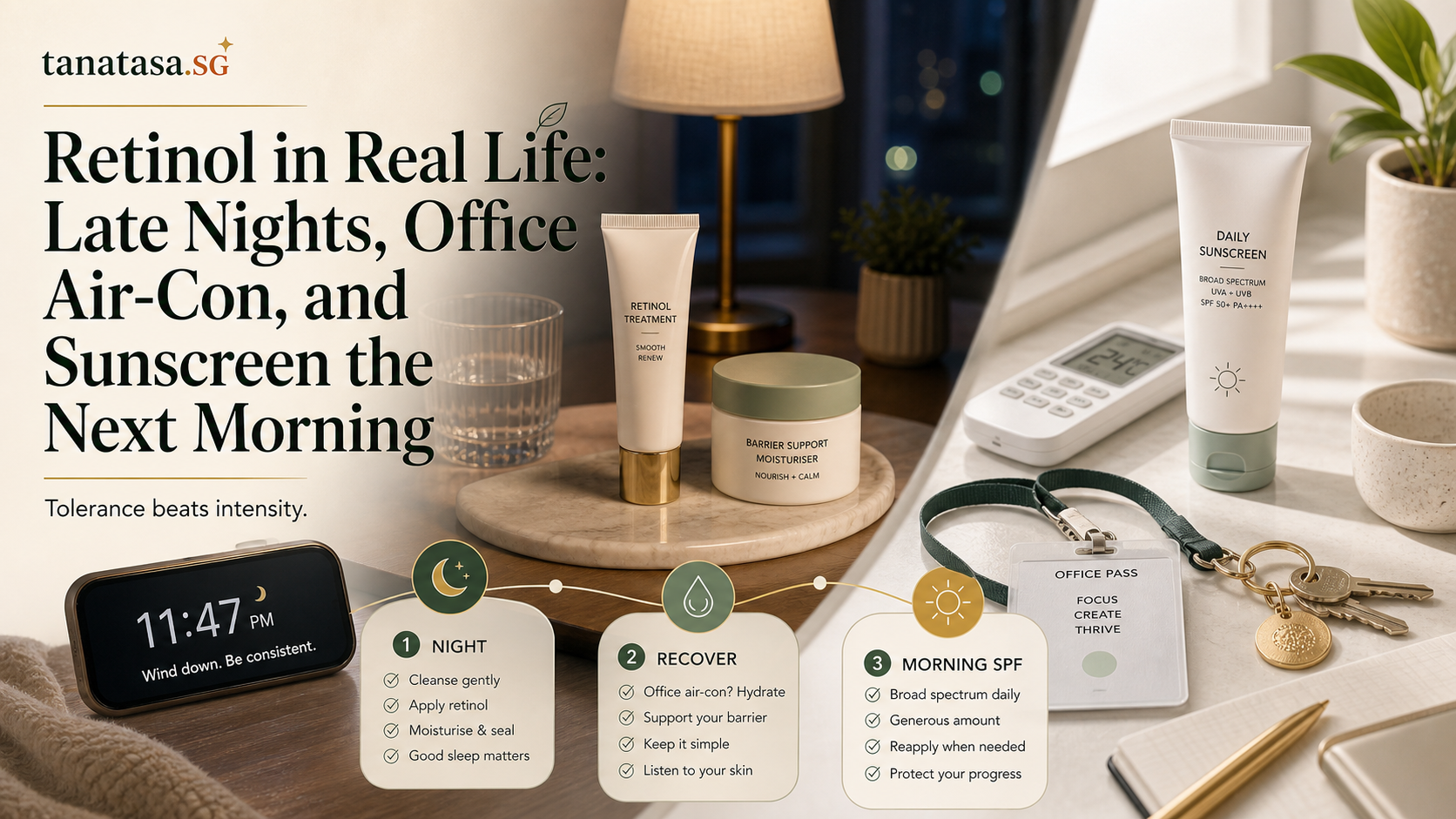
Retinol is one of the most useful skincare categories, and also one of the easiest to misuse. The standard advice sounds simple: apply at night, start slowly, moisturise, wear sunscreen. Most people already know those lines. The harder part is building a routine that survives ordinary life.
Ordinary life is coming home late, washing your face too quickly, sleeping in air-con, forgetting moisturiser, having outdoor plans the next day, using an acid toner because your pores looked annoying, and then wondering why your skin feels tight by Thursday.
Retinol is not the problem in that story. The routine structure is.
What Retinol Is Trying To Do
Retinol is a vitamin A derivative used to support skin renewal. People use it for texture, uneven tone, fine lines, pores, acne-prone skin, and overall skin smoothness. It can be genuinely helpful, but the benefits come from consistent use over time, not from forcing the strongest possible routine immediately.
When retinol irritates, the signs can include dryness, peeling, stinging, redness, tight shiny skin, sensitivity around the nose and mouth, or moisturiser suddenly burning. Those signs do not mean the product is "working better". They usually mean the skin is being pushed faster than it can recover.
Good retinol use is less heroic than people think. It is slow, boring, and very dependent on the rest of the routine.

Choose Retinol Nights On Purpose
Do not use retinol on nights when the routine is already chaotic. If you come home exhausted, scrub your face, skip moisturiser, and sleep under strong air-conditioning, that is not an ideal retinol night. If you know you will be outdoors for a long stretch the next day and your skin is already irritated, that may be a recovery night.
A beginner routine can start with one or two nights a week. Keep those nights simple:
Gentle cleanse.
Let skin dry.
Apply a small amount of retinol.
Moisturise well.
Avoid other strong actives.
If your skin stays calm for several weeks, increase slowly. There is no award for reaching nightly use quickly, especially if your skin barrier collapses halfway there.
The Small Amount Rule Matters
More retinol does not mean faster results. It often means more irritation. Many face retinol products are designed to be used in small amounts. Over-applying because the texture feels nice or because you want faster improvement is one of the most common mistakes.
Apply evenly and avoid the areas that tend to get irritated first: corners of the nose, corners of the mouth, under-eyes unless the product is meant for that area, and broken or freshly treated skin.
If you are using retinol for the body, the logic changes because body skin and product formats differ. A body retinol lotion is not the same shopping decision as a concentrated face serum. Do not use a face routine amount as a guide for the body, and do not assume a body product belongs on the face.
Moisturiser Is Not Optional Decoration
Retinol routines work better when the skin barrier is supported. Moisturiser reduces the feeling that every retinol night is a small punishment. It also helps keep the rest of the routine stable.
If your skin is sensitive, try the sandwich method: moisturiser first, retinol, then another thin layer of moisturiser. This can reduce intensity while your skin adapts. It may slightly buffer the product, but for many people that trade-off is worth it because the routine becomes sustainable.
If you sleep in air-conditioning, moisturiser matters even more. Air-con can make already-retinoid-dry skin feel tighter by morning. This is not a dramatic Singapore-weather point; it is a practical bedroom routine point. If you wake up tight and shiny after retinol nights, your support step may be too light.
Do Not Stack Actives Like A Productivity Plan
The most common retinol mistake is not retinol alone. It is retinol plus acid toner plus brightening serum plus clay mask plus strong cleanser plus spot treatment, all in the same week.
Each product may be reasonable by itself. Together, they can exceed the skin's tolerance.
Be especially careful with:
AHAs and BHAs.
Benzoyl peroxide unless specifically guided.
Strong vitamin C.
Peels and exfoliating pads.
Scrubs.
New acne treatments.
Post-facial or post-laser routines.
You do not need to remove every active forever. You need a schedule that gives skin recovery time. For many people, retinol nights, exfoliation nights, and recovery nights should be separate.
Sunscreen The Next Morning Is Part Of The Routine
Retinol is used at night, but the routine does not end there. The next morning needs sunscreen. Not because one retinol night makes you instantly fragile, but because a proper retinoid routine belongs with daily UV protection, especially if you are using it for pigmentation, texture, or ageing concerns.
If sunscreen stings the morning after retinol, do not ignore that. It may mean the skin barrier is irritated, the retinol frequency is too high, or the sunscreen formula is not compatible with your current skin condition.
The answer is not to skip sunscreen. The answer is to reduce irritation, simplify the routine, and choose a sunscreen your skin can tolerate.
Purging, Irritation, And Wishful Thinking
People often label every bad reaction as purging. That can be risky. Purging usually refers to acne-prone areas bringing existing congestion forward during certain active use. It should be temporary and should happen in areas where you normally break out.
Irritation is different. Burning, widespread redness, rawness, swelling, rashy texture, or breakouts in unusual areas may not be purging. If your skin feels worse in a way that seems inflammatory or painful, pause and reassess.
Do not force yourself through a reaction because the internet said "it gets worse before it gets better". Sometimes it gets worse because the product or frequency is wrong for you.
How To Restart After Irritation
If your skin barrier is upset, stop retinol and other strong actives. Return to gentle cleanser, moisturiser, and sunscreen. Wait until plain moisturiser no longer stings and skin feels normal again.
When you restart, do not restart at the same frequency that caused the problem. Go lower. Use less product. Add more recovery nights. Consider applying over moisturiser. If irritation returns quickly, the product may not be suitable, or you may need professional advice for the concern you are trying to treat.
For prescription retinoids, follow your doctor's instructions rather than general skincare advice.

A Realistic Weekly Shape
A beginner routine might look like this:
Retinol one to two nights a week.
Recovery nights between retinol nights.
No exfoliating acids until skin is stable.
Daily sunscreen.
Moisturiser every night.
One new product at a time.
After several calm weeks, increase only one variable. Do not increase frequency, add acid, change cleanser, and start vitamin C all at once. Your skin cannot give clear feedback if the routine keeps changing.
Bottom Line
Retinol is not a discipline test. It is a long game. The people who get the best results are usually not the ones who use the most product fastest. They are the ones who keep the routine boring enough to continue.
Choose retinol nights carefully, moisturise properly, separate strong actives, use sunscreen the next morning, and pause when your skin is clearly asking for recovery. That is not cautious in a weak way. That is how retinol becomes sustainable.


