Patch Testing New Skincare: Boring, Useful, Underrated
Patch testing is boring because it is sensible. It cannot predict every reaction, but it can stop one new product from turning into a full-routine mystery.
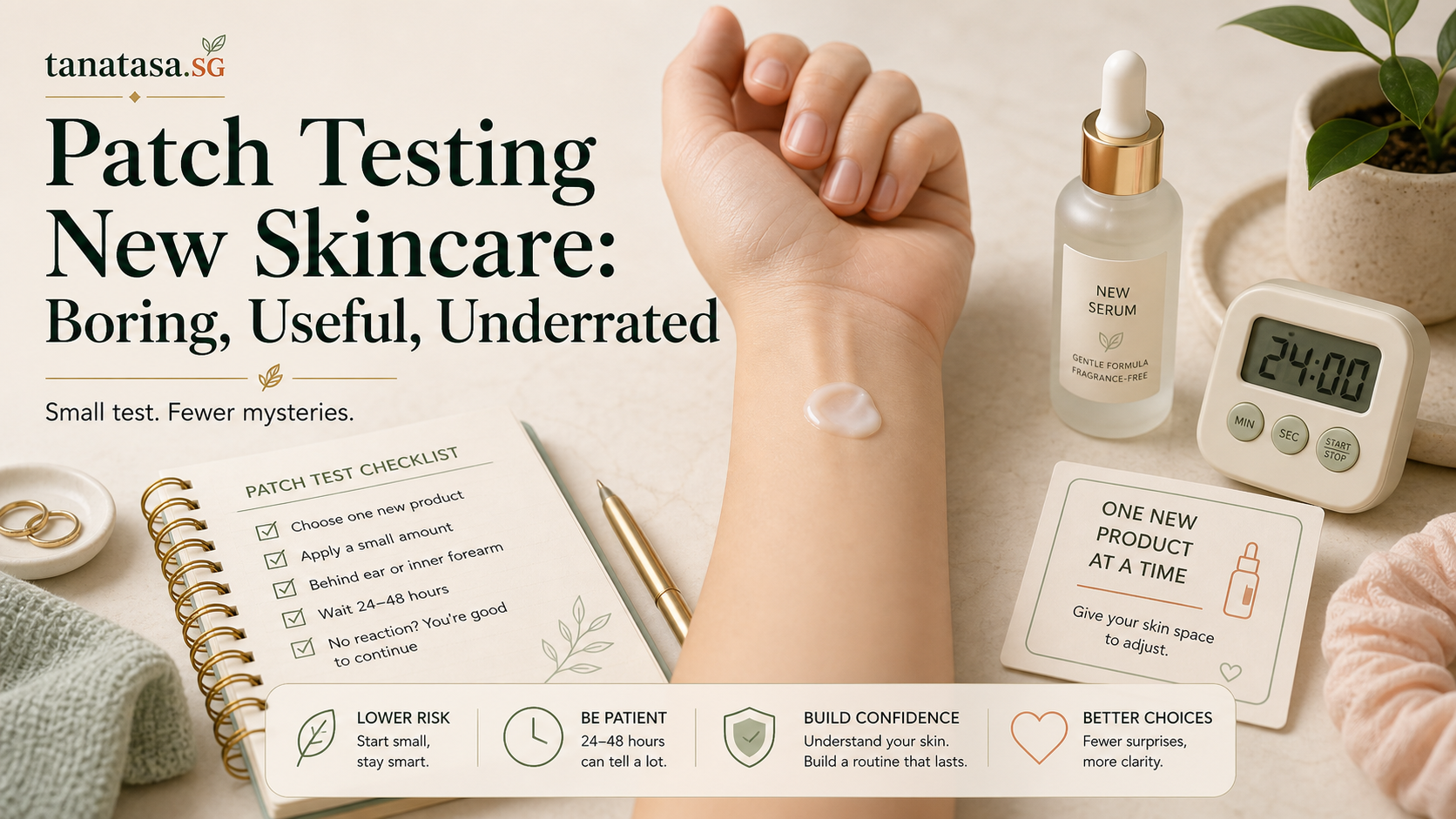
Patch testing is not exciting. It does not make a product work better. It does not give you instant glow. It does not guarantee you will never react. It is simply a small pause before you put a new product across your whole face, body, scalp, or baby's skin.
That pause is useful because skincare reactions are often confusing. If you open a new cleanser, toner, serum, moisturiser, sunscreen, and mask in the same week, and your skin starts stinging, you have created detective work for yourself.
Patch testing is not about fear. It is about reducing confusion.

What Patch Testing Can Do
Patch testing can catch obvious irritation before full use. It can show that a product burns, itches, reddens, or feels wrong on a small area. It can also slow down the habit of using several new products at once.
This is especially useful for:
Leave-on face products.
Sunscreen.
Retinoids.
Exfoliating acids.
Vitamin C.
Benzoyl peroxide.
Eye-area products.
Fragranced products.
Hair dye or scalp products.
Baby products.
Products used after facials, peels, laser, or barrier irritation.
If a small test area reacts quickly, you have saved the rest of your face from joining the experiment.
What Patch Testing Cannot Do
Patch testing cannot predict every reaction. Some reactions are delayed. Some happen only after repeated use. Some occur only when the product is layered with another product. Some happen only on the face because facial skin is less tolerant than the arm. Some breakouts appear after days or weeks.
Patch testing is also not the same as formal allergy patch testing performed by healthcare professionals. If you suspect contact allergy, recurrent dermatitis, or repeated reactions, proper medical assessment may be needed.
So the result "passed patch test" should mean "safe to introduce carefully", not "guaranteed perfect".
Where To Test
The best test area depends on the product and your concern. For face products, people often test near the jaw, behind the ear, or on a small area of the lower cheek where a reaction is easier to notice but not too disruptive. For body products, test on a small body area. For hair or scalp products, test according to product directions, especially for hair dye.
Do not test directly on broken, infected-looking, or severely irritated skin unless directed by a healthcare professional. Patch testing on damaged skin can make the product seem worse than it would be on normal skin, and it can also worsen discomfort.
For products used around the eyes, be careful. Testing near the eye area should be conservative. If you have a history of eyelid reactions, professional advice may be wiser than self-testing repeatedly.
How Long To Watch
There is no perfect consumer patch-test timeline, but a practical approach is to apply a small amount and watch for immediate burning, itching, redness, swelling, rash, or discomfort over the next day or two. For products likely to cause delayed irritation, give more time before full-face use.
If the product directions provide a specific allergy test, especially for hair dye, follow those directions.
Do not ignore a reaction because you want the product to work. A small test exists so you can stop early.

Introduce One Product At A Time
The patch test is only the first step. The next step is slow introduction.
Use the new product while keeping the rest of the routine stable. If you change cleanser, sunscreen, retinol, moisturiser, and toner together, you will not know what helped or hurt.
For basic moisturiser or cleanser, you may be able to introduce more quickly. For actives, go slower. Retinoids, acids, vitamin C, benzoyl peroxide, and brightening treatments need more patience because irritation often depends on frequency.
Active Products Need Frequency Testing
An active can pass a patch test and still be too much if used daily. This is common with retinol, exfoliating acids, benzoyl peroxide, and vitamin C.
Start with fewer uses per week than your enthusiasm suggests. Keep recovery nights. Moisturise properly. Do not stack new actives together.
If your skin stings, flakes, burns with moisturiser, or becomes shiny-tight, reduce frequency or stop. Do not call every irritation "purging". Sometimes the product is simply too strong, too frequent, or wrong for your current barrier.
Sunscreen Patch Testing Has A Special Problem
Sunscreen must be used generously to work, but a patch test uses a small area. A sunscreen may not irritate in a patch test but may sting when applied around the eyes, layered over skincare, worn during sweat, or used in the amount required for proper protection.
After a small patch test, do a normal-day face test when you can observe comfort. Check eye sting, pilling, cast, shine, and whether your skin feels itchy or hot after a few hours.
Do not judge sunscreen only by the first five minutes. Some formulas migrate later.
Patch Testing Baby Products
For baby products, keep the routine simple. Test a small area when introducing a new lotion, wash, or balm, especially if baby skin is dry, rashy, or eczema-prone. Avoid rotating many products at once.
If baby skin is cracked, oozing, infected-looking, spreading quickly, or baby seems very uncomfortable, seek medical advice rather than experimenting with more products.
Keep Notes If Your Skin Is Reactive
If you react often, write down what changed. Product name, date started, where used, how often, symptoms, and when they appeared. Photos in consistent lighting can help.
This may sound excessive, but it saves time. Patterns become easier to see: fragrance, certain sunscreens, exfoliating acids, hair products touching the face, or using too many actives in one week.
If you eventually seek medical advice, this record is useful.
When To Stop
Stop the product if you get burning that persists, swelling, hives, blistering, severe itch, worsening rash, eye swelling, broken skin, or symptoms that worry you. For serious or persistent reactions, seek medical advice.
For mild irritation, stop and simplify. Return to gentle cleanser, moisturiser, and sunscreen if tolerable. Do not immediately replace the product with another new active.
Bottom Line
Patch testing is not a guarantee. It is a way to reduce avoidable confusion. Test small, introduce slowly, change one product at a time, and respect irritation signals.
The point is not to make skincare fearful. The point is to make your routine easier to understand, so one exciting new product does not turn into three weeks of guessing what went wrong.


