How to Read an Ingredient List Without Pretending You Are a Chemist
Ingredient lists are useful, but they are not full formulas. Read them for clues about actives, texture, fragrance, and risk without pretending they answer everything.
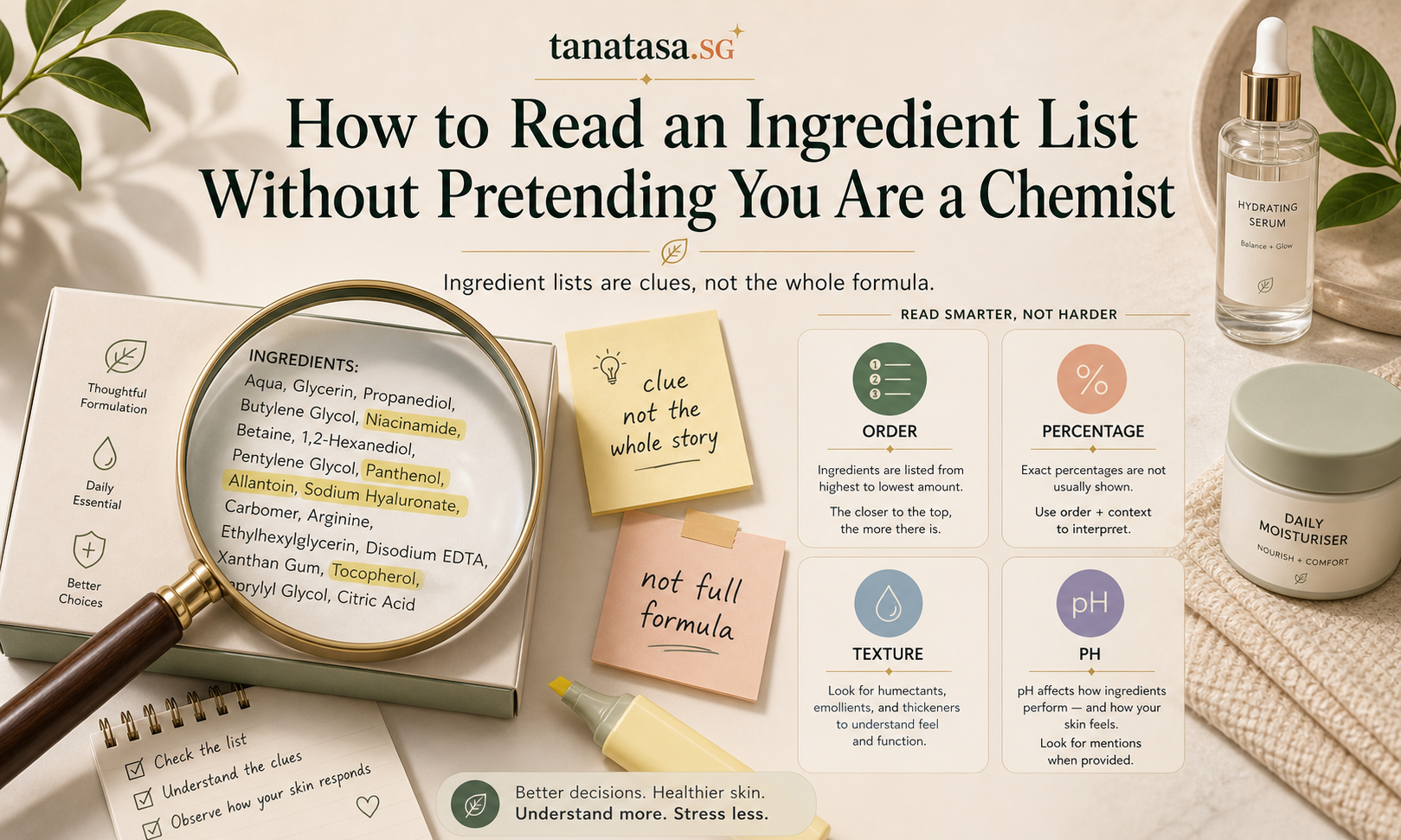
Ingredient lists can make shoppers feel powerful and confused at the same time. You recognise niacinamide, retinol, ceramides, salicylic acid, fragrance, alcohol, glycerin, dimethicone, zinc oxide, and suddenly the product looks like a puzzle you are supposed to solve before checkout.
The trick is to read ingredient lists for clues, not as if they reveal the whole formula. A list can tell you useful things. It can also tempt you into overconfidence.
A skincare product is not just a pile of ingredients. It is a formula: percentages, pH, delivery system, preservatives, texture, packaging, stability, and how all the ingredients behave together.

Ingredient Order Matters, But Not Perfectly
Ingredients are generally listed in descending order of concentration until the lower-percentage zone. That means ingredients near the top are usually present in larger amounts, and ingredients near the end are usually present in smaller amounts.
This is useful. If glycerin is high on the list, the product likely has meaningful humectant character. If an oil or butter is high, the product may feel richer. If fragrance is near the end, it may still matter for sensitive users, but it is probably not a large part of the formula.
But ingredient order does not tell you exact percentages. It also does not reveal pH, stability, particle size, encapsulation, film formation, or how the product feels on skin.
The One-Percent Zone Is Where Certainty Drops
In many cosmetic labelling systems, ingredients under a certain low threshold can be listed in a more flexible order. Shoppers often call this the "one-percent line", although the details can vary by regulation and product context.
The practical takeaway is this: once you reach preservatives, fragrance allergens, colourants, and many botanical extracts, the order becomes less useful as a ranking tool.
Do not confidently declare exact concentrations from the bottom half of a list. You can say an ingredient appears likely to be low. You usually cannot say exactly how low.
Percentages Are Not Always Better
Marketing loves percentages because they feel precise. 10% niacinamide, 2% salicylic acid, 15% vitamin C, 1% retinol. Percentages can be helpful, especially for active products, but higher is not automatically better.
A higher percentage may give a stronger effect. It may also increase irritation. A well-formulated lower-percentage product may suit your skin better than a harsh high-percentage product. For retinoids, acids, vitamin C, and acne treatments, tolerance matters as much as ambition.
Also check what the percentage refers to. Is it the active ingredient itself, a complex, an extract blend, or a raw material mixture? A product can make a percentage sound more impressive than the actual active contribution.
INCI Names Can Sound Scarier Than They Are
Ingredient lists often use INCI names, which can make ordinary ingredients look unfamiliar. Tocopherol is vitamin E. Sodium chloride is salt. Butyrospermum parkii is shea butter. Ascorbic acid is vitamin C. The name sounding chemical does not make the ingredient dangerous.
At the same time, familiar names are not automatically gentle. Lavender oil sounds friendly, but it can irritate some people. Citrus oils sound fresh, but they can be a problem for sensitive users. Natural and synthetic are not safety categories by themselves.
The better question is: what is the ingredient doing in this formula, and is it relevant to my skin?
Ingredient Lists Can Reveal Texture Clues
You can often infer broad texture from the list.
High humectants such as glycerin, propanediol, butylene glycol, hyaluronic acid, or panthenol suggest hydration and water-binding. Oils, butters, petrolatum, waxes, and fatty alcohols suggest richness or occlusion. Silicones such as dimethicone can suggest slip, smoothing, and barrier feel. Alcohol denat. high in the list may suggest a fast-drying texture, especially in sunscreen or toner formats.
These are clues, not verdicts. A formula with oils can still feel elegant. A silicone product can still feel lightweight. A gel cream can still be moisturising if designed well.
Texture is best judged on skin, but the ingredient list can help you avoid obvious mismatches.
Look For The Product Job
A useful ingredient-list read starts with the product job.
For moisturiser, look for humectants, emollients, and occlusives. For sunscreen, look for UV filters and broad protection claims. For acne products, identify whether the main active is salicylic acid, benzoyl peroxide, retinoid, sulfur, or something else. For barrier support, look for ingredients such as ceramides, cholesterol, fatty acids, panthenol, glycerin, petrolatum, or dimethicone depending on the formula.
Do not judge every product by the same ingredient checklist. A cleanser does not need the same active load as a serum. A body lotion does not need to look like a face treatment. A sunscreen should be judged as sunscreen first, not as a skincare serum with SPF.
Fragrance And Allergens Are Worth Spotting
If your skin is sensitive, eczema-prone, or currently irritated, check for fragrance, parfum, essential oils, and known fragrance allergens. You do not need to memorise everything, but obvious scent signals matter when troubleshooting.
If your skin is calm and you enjoy fragrance, the presence of fragrance is not automatically a problem. But if you are trying to simplify a reactive routine, fragrance-free products reduce one common variable.
This is where ingredient lists are genuinely helpful: they can show you patterns across products that irritate you.
Ingredient Lists Cannot Tell You Everything
They cannot tell you:
Whether the product will pill under sunscreen.
Whether your skin will sting.
Whether the texture will feel sticky.
Whether the vitamin C is stable after months of storage.
Whether the sunscreen film forms evenly on your face.
Whether the preservative system is elegant.
Whether the packaging protects the formula well enough.
Whether the product was stored well by the seller.
This is why ingredient-list analysis should not replace patch testing, seller judgement, texture testing, and slow introduction.
Avoid The Fear-List Trap
Online skincare often turns ingredient reading into fear lists: avoid this, never use that, this ingredient is toxic, that ingredient is pore-clogging, this one ruins your barrier. These claims are often too broad.
Dose, formula, product type, skin condition, and context matter. An ingredient that is fine in a rinse-off cleanser may be irritating in a leave-on acid. An oil that clogs one person may comfort another person's dry skin. Alcohol in a sunscreen may help texture for some users and dry out others.
Ingredient literacy should make you calmer, not more afraid of every label.

A Practical Reading Method
Read in this order:
What product category is this?
What job should it do?
What are the first five to ten ingredients suggesting?
Are the active ingredients clear?
Is fragrance or an obvious irritant relevant to my skin?
Does the texture suggested by the list match my preference?
Is the seller clear and reliable?
Can I introduce this without changing everything else?
That method gives you useful information without pretending you are the formulator.
Bottom Line
Ingredient lists are useful, but they are not full formulas. They help you spot actives, fragrance, texture clues, oils, humectants, silicones, and possible mismatch. They do not reveal exact performance, stability, pH, delivery system, or personal tolerance.
Use ingredient lists to ask better questions, not to make final judgements with false confidence. The final answer still comes from formula design, product source, texture, and your skin response.


