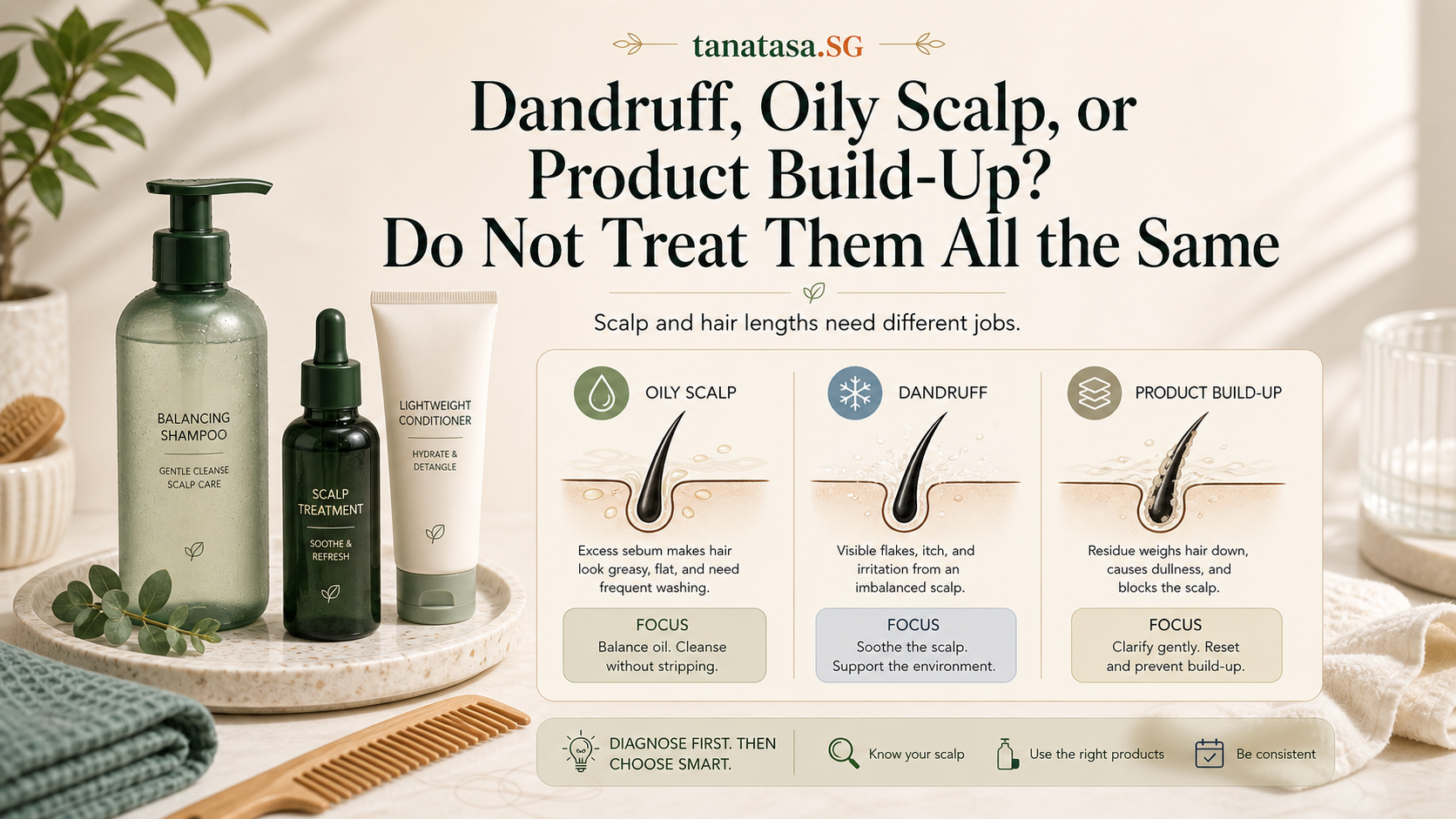
Hair and Scalp Care When Singapore Weather Feels Heavy
A useful guide to hair and scalp care in Singapore humidity: how to separate scalp needs, hair-length needs, dandruff care, and frizz control.

# Hair and Scalp Care When Singapore Weather Feels Heavy
Singapore weather can make hair care confusing because the scalp and hair lengths often behave like they need opposite things.
Your scalp may feel oily by afternoon. Your roots may look flat after a short walk outdoors. At the same time, your ends may feel dry, rough, or frizzy from air-conditioning, heat, and repeated washing.
This is why one all-purpose hair routine often fails in humid weather. If you use products that are too rich, the scalp feels heavy. If you cleanse too aggressively, the ends feel dry and punished. The solution is not necessarily more products. It is knowing which part of the hair each product is meant for.

Treat the scalp and hair lengths separately
The first rule is simple: shampoo is mainly for the scalp. Conditioner, masks, and oils are mainly for the hair lengths and ends.
This matters because the scalp is living skin. It produces oil, sweats, reacts to buildup, and can become itchy or flaky. The hair lengths, on the other hand, are older fibre. They do not produce oil on their own and are more likely to become dry, frizzy, or rough, especially after sun exposure, heat styling, colouring, or air-conditioning.
Many hair routines go wrong because the same product is applied everywhere.
Heavy conditioner near the roots can make the scalp feel greasy faster. Rich oils applied too close to the scalp can make hair look limp. Strong cleansing applied all the way down the hair can make the ends feel dry even if the scalp needed a proper wash.
A better approach is to separate the jobs.
When shampooing, focus on the scalp and roots. Massage gently with your fingertips, not your nails, then rinse thoroughly. The shampoo that runs through the lengths during rinsing is usually enough to clean the rest of the hair.
A dedicated shampoo such as L'Oreal Advanced Care 300 ml Shampoo L'OrealL'Oreal Professionnel Serioxyl Shampoo 100mlL'Oreal Professionnel Serioxyl Shampoo 100ml is a shampoo for hair and scalp care routines. It is the 100ml option, supplied as one retail unit of the selected variant.S$11.90
S$14.00 is a better category fit than using body wash or an overly rich cleansing product on the scalp.
Why the scalp feels heavy so quickly in Singapore
Humidity affects the scalp in several ways. Heat increases sweating. Humidity slows evaporation. Sebum, sweat, styling product, sunscreen around the hairline, and environmental particles can sit on the scalp longer than they would in a drier climate.
This can make the scalp feel oily, coated, or uncomfortable even when the hair lengths still look dry.
For people who commute, exercise, wear helmets, spend time outdoors, or move between air-conditioning and outdoor heat, this buildup can happen quickly. The instinct is often to wash more aggressively. But stronger cleansing is not always better. A harsh shampoo can strip the scalp, make the hair lengths rough, and create a cycle where the scalp feels uncomfortable again soon after washing.
A good humid-weather shampoo should clean the scalp properly without making the hair feel squeaky, stiff, or straw-like after rinsing.
Dandruff and oiliness are not the same problem
An oily scalp does not always mean the scalp simply needs more washing.
If you notice flakes, itch, scalp discomfort, redness, or recurring irritation, treat it differently from normal oiliness. Dandruff is often linked to scalp imbalance and yeast activity, not just dirt or sweat. Washing more often with a regular shampoo may not solve the underlying issue, and in some cases it can make the scalp feel more irritated.
This is where a targeted dandruff shampoo makes more sense than repeatedly switching between random shampoos.
For a dandruff-prone scalp, Vanicream Dandruff Care 355 ml Shampoo VanicreamVanicream Hair Care 355ml ShampooVanicream Hair Care 355ml Shampoo is a shampoo for sensitive scalp and hair-care routines. It is the 355ml option, supplied as one retail unit of the selected variant.S$31.15
S$50.00 is the kind of product to consider because it belongs to a more specific scalp-care category.
The important part is consistency. Dandruff care usually needs repeated use over time. Using a targeted shampoo once, then abandoning it immediately because flakes do not disappear overnight, may not give the product enough time to work.
Conditioner belongs mostly on the lengths and ends
In Singapore, many people avoid conditioner because they worry it will make hair flat. That can happen, but usually because conditioner is applied too close to the scalp or the formula is too heavy for the hair type.
Conditioner is still useful, especially for mid-lengths and ends. These parts of the hair are older and more exposed to friction, UV, washing, towels, brushing, and heat. Without enough conditioning, the ends can become rough and frizzy even when the scalp is oily.
Apply conditioner from the mid-lengths to the ends. Avoid the scalp unless the product is specifically designed for scalp use. Let it sit briefly, then rinse well.
If your hair is fine or easily weighed down, use less product and focus only on the last third of the hair. If your hair is thick, wavy, coloured, or dry, you may need a richer conditioner or occasional mask, but still keep it away from the roots if your scalp gets oily quickly.
Dry ends need a lighter hand in humid weather
Frizz is common in Singapore because humid air interacts with the hair fibre. When the cuticle is rough or lifted, moisture in the air enters unevenly, causing hair to swell and frizz.
The answer is not always more oil. Too much oil in humid weather can make hair feel coated, sticky, or limp. It can also transfer to the neck, face, or scalp, especially in hot weather.
For rough ends, start small. Apply treatment only from the mid-lengths to the ends. Use a tiny amount first, then add more only if needed.
L'Oreal Absolut Repair Oil is an example of a product that belongs in the hair-length part of the routine. It should not be treated as a scalp product. Used sparingly, this type of product can help smooth the ends and reduce roughness. Used too generously, especially near the roots, it can make hair feel heavy.
In Singapore weather, the goal is controlled smoothing, not coating the hair.

Do not test too many hair products at once
Hair and scalp routines are easier to understand when you change one thing at a time.
If you switch shampoo, conditioner, hair oil, scalp treatment, and styling product in the same week, it becomes impossible to know what helped or what caused a problem. If the scalp becomes itchy, was it the shampoo? If the hair becomes flat, was it the conditioner or the oil? If the ends feel smoother, which product actually made the difference?
Testing one product at a time gives you a clearer answer.
Smaller formats can be useful for this. If you are testing a scalp product, a travel size such as L'Oreal Serioxyl Shampoo travel size lets you judge how your scalp feels over a few washes before committing to a full-size bottle.
This is especially useful in Singapore, where scalp feel can change quickly depending on weather, exercise, commute, and air-conditioning exposure.
A practical humid-weather routine
For an oily or heavy scalp, shampoo the roots well and rinse thoroughly. Avoid conditioner at the roots. Do not assume that washing harder is better. The scalp should feel clean, not stripped.
For dry or frizzy ends, condition the mid-lengths and ends. Use oil or leave-in treatment sparingly, and keep it away from the scalp.
For dandruff-prone scalp, use a targeted dandruff shampoo consistently. Treat flakes and itch as a scalp-care issue, not just an oil issue.
For flat hair, avoid heavy masks, oils, and leave-ins near the roots. Use richer products only where the hair actually needs them.
For product testing, change one product at a time and give it a few washes before judging.
The simple rule
A good Singapore hair routine should leave the scalp clean without making the ends feel punished.
That usually means cleansing the scalp properly, conditioning the lengths thoughtfully, using oils lightly, and treating dandruff or scalp discomfort as a separate issue from normal oiliness.
Humidity does not mean your hair routine has to be complicated. It just means your scalp and your ends may need different care.
Compare current hair-care formats
When you are ready to compare products, browse the hair-care collection by shampoo, treatment, formulation, price and current availability. Use the product page to confirm the exact size and directions before ordering.