Fragrance-Free, Unscented, Essential Oils: The Scent Label Trap
Fragrance-free, unscented, naturally scented, and essential-oil labels are not interchangeable. The difference matters most when skin is reactive.
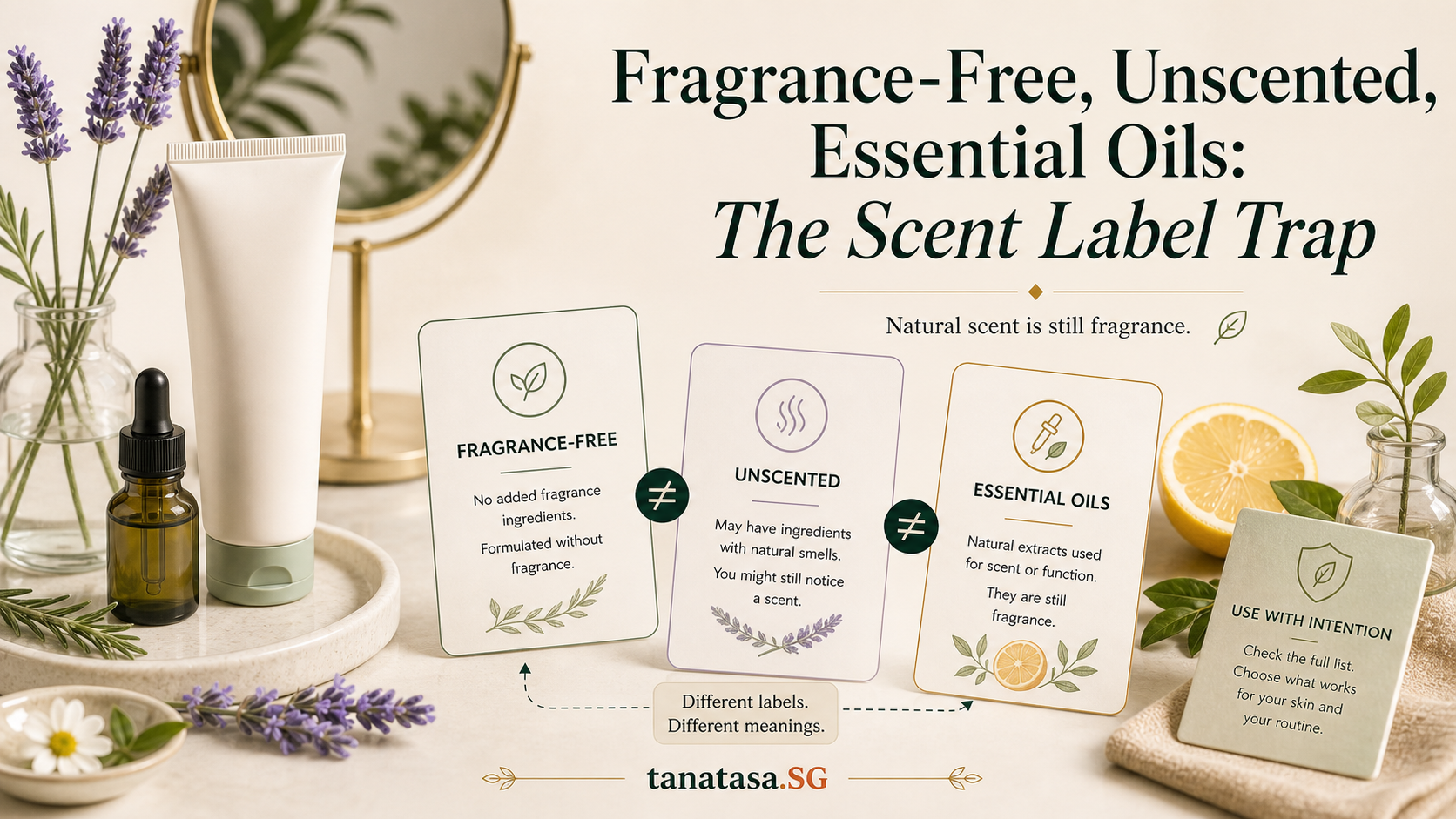
Scent labels are more confusing than they look. Fragrance-free, unscented, naturally scented, essential-oil blend, botanical aroma, perfume-free, no artificial fragrance: these phrases often sit close together in beauty marketing, but they do not all mean the same thing.
For many people, fragrance is not a problem. A scented body wash, shampoo, hand cream, or perfume can be part of the pleasure of using beauty products. The issue is not whether scent is good or bad. The issue is whether your skin can tolerate that formula, in that product type, at that moment.
The distinction matters most when skin is sensitive, eczema-prone, recently over-exfoliated, post-treatment, irritated around the eyes and neck, or reacting without an obvious cause.

Fragrance-Free Is The Clearest Starting Point
Fragrance-free usually means fragrance ingredients have not been added for the purpose of scenting the product. If you are trying to remove scent as an irritation variable, this is generally the clearest label to look for.
Fragrance-free does not mean the product has no smell. Raw ingredients have their own odours. A fragrance-free moisturiser may smell like its base formula. A sunscreen may smell like UV filters. A treatment product may have a medicinal or chemical smell. That does not automatically mean fragrance has been added.
Fragrance-free also does not guarantee the product will be gentle. A fragrance-free exfoliating acid, retinoid, vitamin C, or acne treatment can still irritate. Fragrance is only one variable.
Unscented Is Not Always Fragrance-Free
Unscented usually means the finished product has little or no noticeable smell. Sometimes that is because no fragrance was added. Sometimes it is because masking fragrance was used to cover the natural smell of the formula.
This is why unscented is not always the same as fragrance-free. If your goal is simply to avoid a strong smell, unscented may be fine. If your goal is to reduce fragrance exposure because your skin reacts, fragrance-free is usually more useful.
For products used on the face, neck, eyelids, baby skin, or irritated areas, this distinction can matter. For a hand wash or rinse-off body wash, you may choose differently depending on your tolerance.
Essential Oils Are Still Fragrance Components
Essential oils are natural, but natural does not mean irritation-proof. Lavender, citrus, peppermint, eucalyptus, tea tree, rosemary, rose, geranium, and many botanical oils can smell beautiful. They can also irritate some people, especially in leave-on products or when the skin barrier is already stressed.
This does not mean every essential oil product is bad. It means "naturally scented" should not be treated as automatically safer than synthetic fragrance.
If your skin is calm and you enjoy scented products, you may not need to avoid them completely. If you are troubleshooting irritation, essential oils belong on the list of variables to remove temporarily.

Leave-On Products Deserve More Caution
The same fragrance level can matter differently depending on product type.
A rinse-off cleanser or body wash has limited skin contact compared with a leave-on moisturiser, serum, sunscreen, deodorant, or body lotion. A scented shampoo may irritate the scalp or neck for some people, but others tolerate it well because it is rinsed away. A fragranced face cream stays on the skin for hours.
If you are sensitive, prioritise fragrance-free choices for leave-on products first:
Face moisturiser.
Sunscreen.
Eye-area products.
Neck creams.
Barrier repair products.
Baby moisturisers.
Products used after shaving, exfoliation, facials, peels, or laser.
You may still tolerate scent in shampoo, wash-off masks, or body wash. The routine does not have to be all-or-nothing.
The Face, Neck, And Eyes Are Often Less Forgiving
Many people tolerate fragranced body products but react to fragranced face products. The eyelids and neck are especially common areas for sensitivity. A product applied to hair, hands, or face can also transfer to those areas.
If you keep getting irritation around the eyes, do not only check eye cream. Look at sunscreen, cleanser, shampoo, hair styling products, hand cream, nail products, and fragrance transfer from fingers. The source is not always the most obvious product.
For persistent eyelid irritation, swelling, or rash, get proper medical advice. Guessing through product after product can take months.
Fragrance Can Hide In Ingredient Lists
Ingredient lists may use words such as fragrance, parfum, aroma, essential oil names, limonene, linalool, citronellol, geraniol, eugenol, citral, and other fragrance components depending on the product and labelling rules.
You do not need to memorise every fragrance allergen. But if you are troubleshooting, learn to spot the obvious scent signals: fragrance, parfum, essential oils, citrus oils, floral oils, mint oils, and botanical aroma claims.
Also remember that a product can smell strong because of its base ingredients without added fragrance. Ingredient reading gives clues, not the full story.
When Fragrance Is Fine
If your skin is calm, you like the product, and it does not cause issues, fragrance may be a perfectly reasonable part of your routine. Enjoyment matters. A body lotion you love using is more useful than a fragrance-free cream you avoid because you dislike the texture.
The key is context. Do not introduce a fragranced active when your barrier is already irritated. Do not use a scented product on baby skin just because the packaging looks gentle. Do not assume natural scent is safer. But also do not feel that every pleasant-smelling product is automatically irresponsible.
Skincare should be careful, not joyless.
How To Troubleshoot Scent Sensitivity
If you suspect fragrance is a problem:
Stop new scented leave-on products first.
Switch face moisturiser and sunscreen to fragrance-free options.
Keep cleanser gentle and simple.
Check hair products if irritation appears around the hairline, neck, or eyes.
Avoid essential-oil-heavy products during the reset.
Reintroduce one product at a time once skin is calm.
If symptoms are severe, persistent, swollen, blistering, or recurring in the same pattern, seek medical advice. You may need proper assessment rather than more product rotation.
Bottom Line
Fragrance-free, unscented, naturally scented, and essential-oil-based are not interchangeable labels. Fragrance-free is usually the clearest choice when you are trying to reduce scent as an irritation variable. Unscented mainly tells you about smell, not always ingredients. Essential oils are natural, but still fragrance components.
The question is not whether scent is morally good or bad. The question is whether your skin can tolerate that product, in that format, during the skin condition you have right now.