Acne Products at Watsons and Guardian: What to Know Before Buying Everything
Acne shelves can push you toward too many products at once. This guide explains what each common category does, what to avoid stacking, and when to seek proper care.
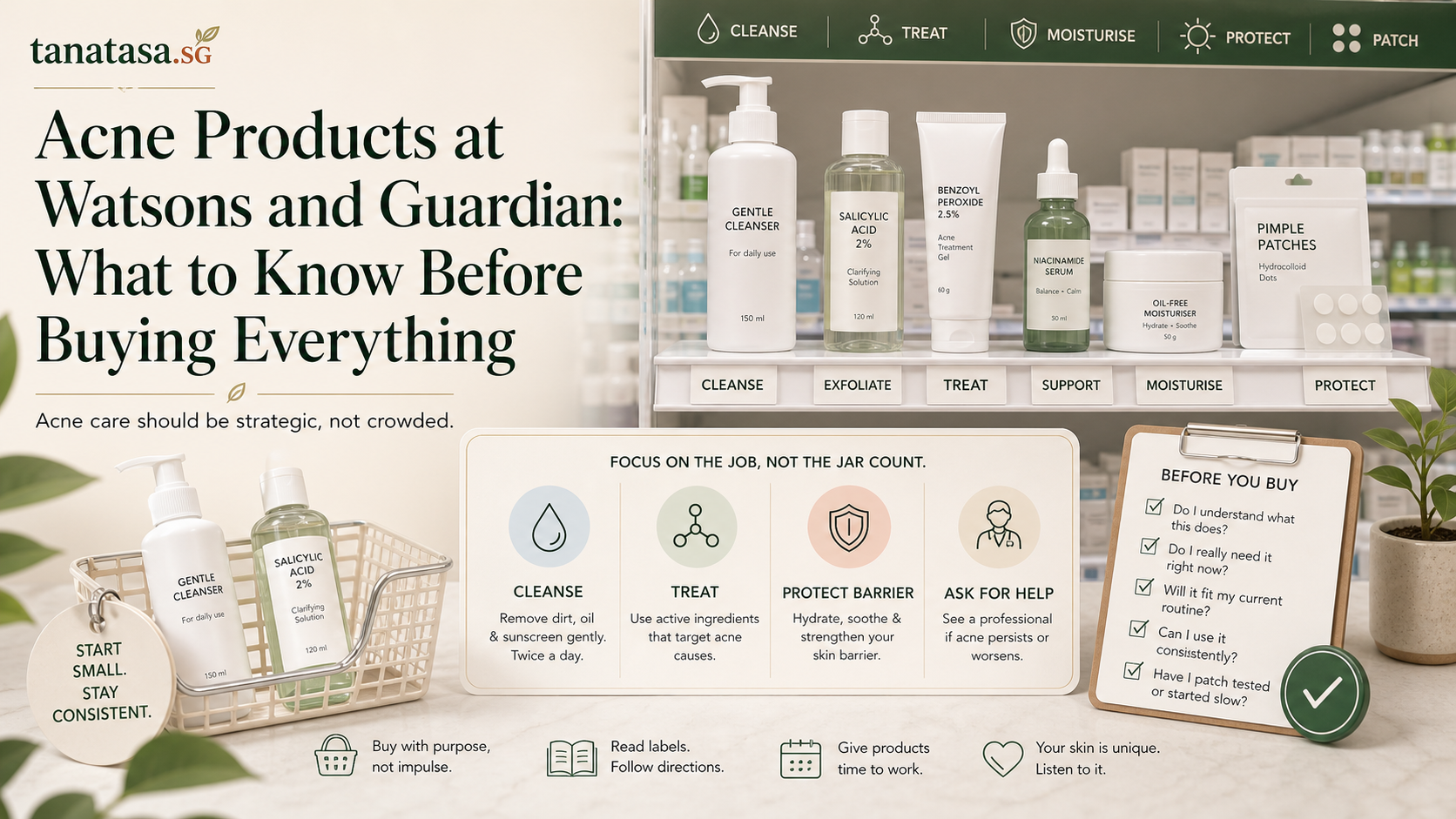
Acne shopping can turn into a basket very quickly. One cleanser says oil control. One toner says pore clearing. One patch says overnight flattening. One spot treatment says fast action. One moisturiser says non-comedogenic. The shelf makes it feel as if acne needs a full routine overhaul immediately.
Sometimes acne does need a clearer routine. But more acne products do not automatically mean better acne control. Very often, more products mean more irritation layered on top of acne.
The useful way to shop at Watsons, Guardian, Unity, or any pharmacy shelf is to understand what each category is meant to do, choose one meaningful change at a time, and know when the problem has moved beyond retail skincare.

First, Identify The Pattern
"Acne" is not one single shopping problem. Whiteheads, blackheads, oily congestion, inflamed pimples, deep painful bumps, hormonal patterns, mask-related breakouts, folliculitis-like bumps, and irritation bumps can look similar to a frustrated shopper but need different approaches.
If you mostly have clogged pores and blackheads, a salicylic acid product may be relevant. If you have inflamed pimples, benzoyl peroxide may be useful for some people. If you are picking at spots, pimple patches can protect the area. If your skin burns and flakes after multiple acne products, the priority may be barrier recovery, not stronger treatment.
Before buying, ask: what type of breakout am I trying to manage, and what job should this product do?
Cleansers Support The Routine
An acne cleanser can help, but cleanser is not always the main treatment. It is on the skin briefly, then rinsed off. A gentle cleanser used consistently may be more useful than a harsh cleanser that makes your face feel tight and squeaky.
For oily skin, a foaming or gel cleanser can feel better. For irritated acne-prone skin, a gentler cleanser may be smarter. If your current cleanser leaves skin tight, red, or stinging, switching to something less stripping may improve the routine even before adding treatment.
Do not wash aggressively to "remove acne". Over-cleansing can worsen dryness, trigger more irritation, and make active treatments harder to tolerate.
Salicylic Acid Is For Congestion, Not Every Spot
Salicylic acid, also called BHA, is oil-soluble and often used for blackheads, clogged pores, and oily congestion. It can be useful around the nose, forehead, chin, or areas where pores clog repeatedly.
The mistake is using salicylic acid everywhere, every day, alongside other strong products, and expecting skin to stay calm. Leave-on salicylic acid products can irritate if used too often, especially when combined with retinoids, benzoyl peroxide, exfoliating pads, or strong cleansers.
Start slowly. Use it on the areas that need it. Keep moisturiser in the routine. If skin becomes shiny-tight, flaky, or stinging, reduce frequency.
Benzoyl Peroxide Can Help Inflammatory Acne
Benzoyl peroxide can help some inflammatory acne, but it deserves respect. It can be drying, irritating, and it can bleach towels, pillowcases, and clothing. That does not make it bad. It means you should use it deliberately.
Some products are wash-off; some are leave-on. Follow the product directions. Do not layer benzoyl peroxide casually with every other active in your bathroom. If you are using prescription acne medication, follow your healthcare professional's advice rather than improvising combinations.
If your acne is painful, cystic, scarring, or persistent, benzoyl peroxide from a shelf may not be enough. That is not a personal failure. It is a sign to get proper care.
Pimple Patches Are Useful, But Specific
Hydrocolloid pimple patches are helpful when a pimple has come to a head or when you need to stop yourself from picking. They protect the spot, absorb fluid, and reduce the temptation to touch.
They are not magic stickers for every type of acne. They do not treat deep cystic acne in a meaningful way. They do not prevent new breakouts by themselves. They can also irritate if used on already damaged skin or if removed aggressively.
Use patches for the job they are good at: protecting selected spots and reducing picking.
Moisturiser Is Still Part Of Acne Care
People with acne-prone skin often fear moisturiser because they worry it will clog pores. The right moisturiser can actually make acne treatment more tolerable. If active products dry your skin out, you may end up with irritation, peeling, and more inflammation.
Look for textures your skin can accept: gel creams, lightweight lotions, or non-comedogenic formulas if that label helps you shortlist. But do not treat "oil-free" as the only safe category. Formula matters more than one marketing phrase.
If every moisturiser feels heavy, use less and apply to damp skin, or choose a lighter texture. Do not skip moisturiser while using drying acne treatments and then wonder why your skin barrier is upset.

Do Not Change Five Products At Once
This is the most practical acne rule. If you start a new cleanser, toner, serum, spot treatment, moisturiser, and sunscreen in the same week, you will not know what helped or what irritated you.
Make one meaningful change. Give it time. Keep the rest of the routine stable. Take photos in consistent lighting if that helps you judge progress more fairly.
A simple acne routine might be:
Gentle cleanser.
One treatment category chosen for your acne pattern.
Moisturiser.
Sunscreen in the morning.
Pimple patches only when useful.
That may look less exciting than a full basket, but it gives your skin a clearer chance to respond.
Watch For Irritation Masquerading As Acne
If your skin has tiny rough bumps, burning, redness, peeling, and breakouts after starting several products, you may be looking at irritation rather than acne progression. Adding stronger acne products can make this worse.
Signs to simplify:
Plain moisturiser stings.
Skin feels tight and shiny.
Flaking appears around the mouth or nose.
Breakouts appear in unusual areas.
Everything you apply burns.
In that situation, pause strong actives and rebuild the routine. Acne treatment works better when the barrier can tolerate it.
When Retail Acne Products Are Not Enough
See a doctor, dermatologist, or appropriate healthcare professional if acne is painful, deep, cystic, scarring, spreading quickly, emotionally distressing, or not improving after a reasonable attempt. Also seek advice if acne appears suddenly in adulthood, is associated with other symptoms, or if you are pregnant and unsure what is safe.
Singapore has several care routes: GP, polyclinic, dermatologist, or pharmacist guidance for selected over-the-counter options. Getting help early can prevent scarring and months of expensive trial-and-error shopping.
Bring photos, a product list, and a timeline. That is more useful than arriving with a bag of half-used products and no memory of what changed when.
Bottom Line
Acne shelves are full because acne has many possible product jobs. Your routine does not need to buy all of them.
Choose based on the breakout pattern. Use one active category at a time. Keep cleanser and moisturiser boring. Use pimple patches for protection, not miracles. Watch for irritation. And when acne is painful, scarring, persistent, or severe, stop treating the retail shelf like a doctor.


